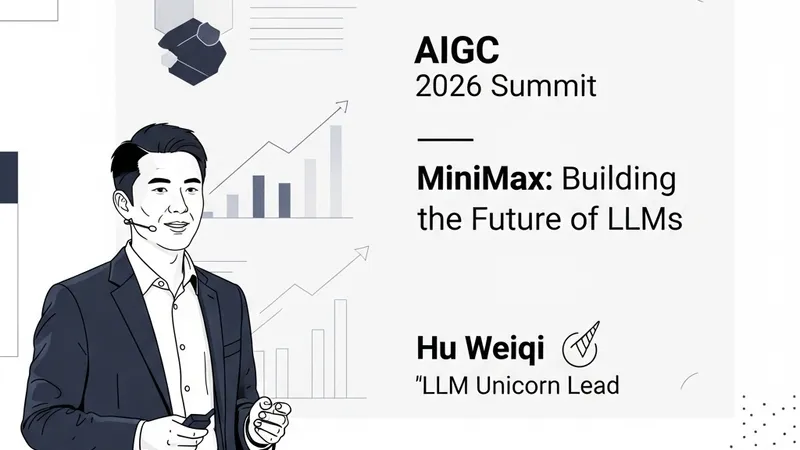
At the AIGC 2026 China Summit, Hu Weiqi, ToB China Commercialization Lead at MiniMax, shared profound insights into the company's internal evolution into an "AI-Native" organization. Hu emphasized that generative AI has transitioned from a mere novelty or "toy" into a core productivity driver, radically reshaping modern organizational structures. From its inception, MiniMax has focused on exploring next-generation AI paradigms, aiming to build agents capable of passing the Turing test and delivering exceptional user experiences.
According to Hu, AGI represents "Intelligence with Everyone"—affordable and accessible smart systems for all. To achieve this, MiniMax maintains a balanced strategy: co-developing large models and applications, and driving both ToC and ToB markets. In the B2B sector, LLMs have deeply integrated into enterprise production. A significant shift is observed among developers who are increasingly adopting 'Vibe Coding'—writing software entirely via AI generation without manual coding. This confirms AI's evolution into an indispensable organizational multiplier.
Hu outlined three core practices for building an AI-Native organization: First, initiate AI integration in high-value scenarios that employees dislike most, which drastically reduces implementation friction. Second, establish an internal closed-loop by offering generous 'token subsidies' to encourage employees to construct automated Agent workflows, using token consumption as a new KPI for operational efficiency. Third, AI enables flat organizational architectures where product managers can generate functioning Demos directly, effectively blurring the boundaries between frontend and backend engineering.
She also mapped MiniMax's product timeline: from the 2023 emotional companion app 'Xingye,' to the highly-acclaimed 'Hailuo AI' video generator in 2024, the breakthrough M2 text series in 2025 enabling enterprise agents, and finally, the rapid launch of MaxClaw Agent, MaxClaw, and MaxHermes in early 2026. This aggressive tool-layer iteration demonstrates that models are no longer just execution endpoints but can drive the evolution of the tools themselves.
[AgentUpdate Depth Analysis] MiniMax's internal "all-agent" workflow and "unlimited token" culture highlight a crucial shift in AI-native organizations. Unlike traditional enterprises that enforce top-down AI tools, MiniMax leverages bottom-up grassroots automation by treating token consumption as an efficiency metric. Compared to standard orchestration frameworks like LangChain or emerging standards like MCP (Model Context Protocol), MiniMax’s approach focuses on organizational low-friction experimentation. By shifting the corporate bottleneck from human labor hours to compute allocation, MiniMax demonstrates that the ultimate value of AI Agents lies in their tight, autonomous coupling with enterprise business logic. Organizations that foster an internal "agentic market" will inevitably outpace traditional, hierarchical development structures.