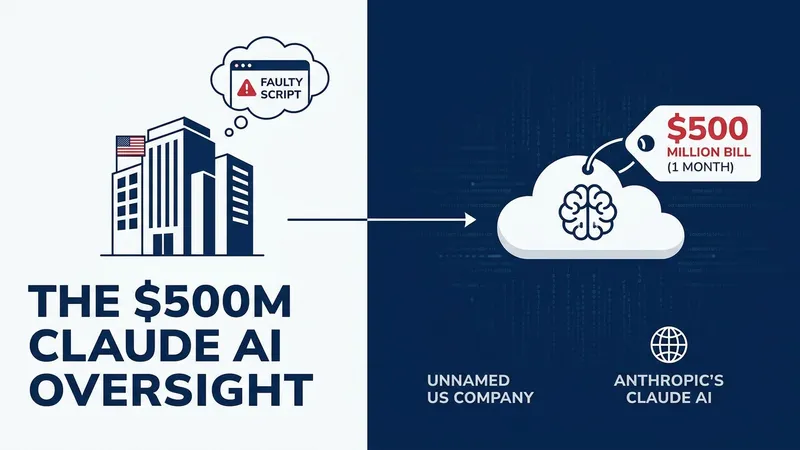
According to a report by Axios, an unnamed U.S. company managed to spend a staggering $500 million on Anthropic's Claude AI in a single month. The root cause of this massive expenditure was a simple administrative oversight: the organization failed to set usage limits on the Claude licenses distributed to its employees. While the identity of the company remains confidential, observers note that very few enterprises in the world possess the financial capacity to spend half a billion dollars monthly on third-party AI without having developed their own proprietary LLM capabilities.
This incident underscores the mounting pressure and anxiety within enterprise leadership regarding runaway AI expenditures. Corporate executives are increasingly questioning whether these skyrocketing costs are translating into tangible productivity gains or genuine business returns. This is not an isolated issue of AI mismanagement; Amazon was also recently reported to have faced challenges where employees inflated token consumption to meet internal adoption metrics. In response, Amazon quietly dismantled its internal AI usage leaderboards this week to prevent staff from executing unnecessary AI tasks just to boost their standings.
[AgentUpdate Depth Analysis] This $500M blunder exposes a critical "governance vacuum" in the current enterprise AI wave. As organizations transition from static chatbots to autonomous AI Agents, the absence of robust AI FinOps—such as dynamic token routing, cost-quota limiting, and real-time usage monitoring—poses immense financial risks. Unlike traditional software licensing, generative AI consumption is highly elastic and unpredictable. To enable the long-term success of the AI Agent ecosystem, the industry urgently needs standardized agent gateways, automated circuit-breakers, and protocol-level constraints (like MCP) that govern resource consumption. Without these guardrails, enterprise adoption of advanced Agentic workflows will be severely hindered by ROI skepticism and fiscal volatility.