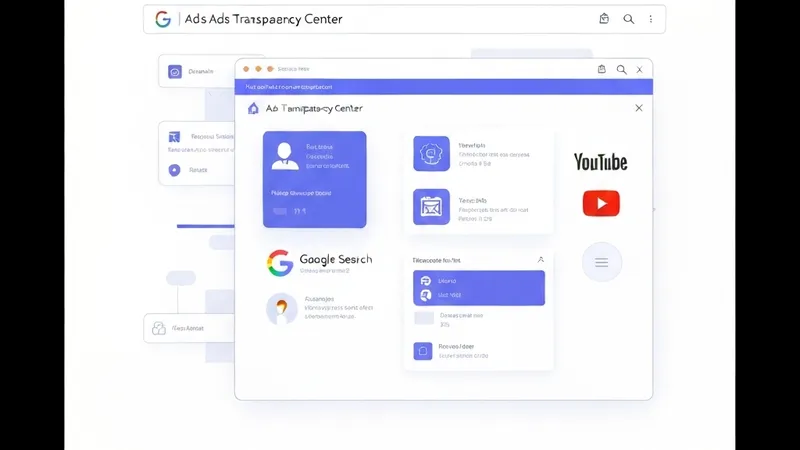
The Google Ads Transparency Center is one of the most underutilized datasets in marketing. Launched in 2023 under the EU Digital Services Act and parallel US regulatory pressure, it indexes every active campaign currently running across Google Search, YouTube, Display, Shopping, Maps, and Play—all mapped directly to verified advertisers. For a major brand like Nike, Google indexes over 300,000 active creatives; for your typical competitor, it usually hovers between 50 and 500.
The major roadblock, however, is that Google provides no official download or export feature. The interactive UI forces users to manually click through paginated lists showing only 40 creatives at a time. To leverage this wealth of information for competitor sweeps, trademark audits, or feeding a RAG corpus, programmatically extracting the data is the only viable path. Here is a breakdown of what that extraction actually takes and how it can be simplified into a single API call.
What is the Google Ads Transparency Center?
Operated directly by Google, the Ads Transparency Center is a public registry designed to comply with ad-disclosure regulations. Because of its compliance nature, the data is entirely public by design. Per advertiser, it reveals:
- Every active or recently live ad creative (text, image, and video)
- The target landing domains the ads redirect to
- First-shown and last-shown timestamps, along with approximate impression statistics
- Deep links to each specific creative inside the Transparency Center
What it fails to deliver is a keyword-based search mode, server-side regional filtering, or—crucially—an official API.
Does an Official API Exist?
No. As of 2026, Google provides no official API or bulk export tools for the Ads Transparency Center. The only programmatic interface is the internal SearchService/SearchCreatives RPC endpoint used by the website itself. This endpoint remains undocumented, outputs a positional Protobuf-style array instead of labeled JSON, and strictly analyzes incoming TLS fingerprints before serving responses. Achieving reliable extraction is the main challenge, which is why developers turn to dedicated hosted scrapers rather than basic script snippets.
Structure of the Extracted Data
Each scraped ad creative is mapped into a flat, typed JSON object. Here is an example of what the returned schema looks like:
{
  "advertiser_id": "AR18378488041124659201",
  "advertiser_name": "Nike Retail BV",
  "creative_id": "CR15771942603307614209",
  "creative_url": "https://adstransparency.google.com/advertiser/AR18378488041124659201/creative/CR15771942603307614209?region=anywhere",
  "landing_domain": "nike.com",
  "format_type": 1,
  "first_shown_ts": 1761145
}
Utilizing a pre-built tool like an Apify Actor allows developers to bulk-extract this data for approximately $1.20 per 1,000 ads ($0.0012 per ad), while bypassing the complexities of TLS fingerprinting, proxy rotation, and pagination management.
[AgentUpdate Depth Analysis] The shift from static data retrieval to autonomous AI Agents highlights the critical need for real-time, high-fidelity data channels. Overcoming complex web obstacles like Google's internal Protobuf-style RPCs and strict TLS fingerprinting is no longer just a scraping challenge—it is a foundational requirement for building "perceptive" AI Agents. By feeding highly structured competitor ad intelligence directly into RAG (Retrieval-Augmented Generation) pipelines, AI Agents can move past historical training limits to dynamically analyze market shifts, audit trademarks, and generate optimized ad copy in real time. This capability represents a significant milestone in agentic workflows, transforming raw public registries into actionable, closed-loop strategic assets for automated enterprise execution.