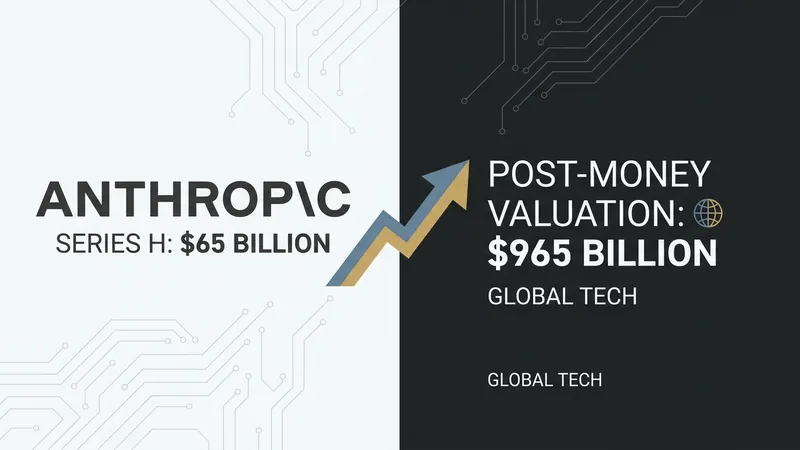
In a blog post on Thursday, Anthropic announced that it has raised $65 billion in Series H funding led by Altimeter Capital, Dragoneer, Greenoaks, and Sequoia Capital, valuing the company at $965 billion post-money. This pushes Anthropic past OpenAI’s last reported valuation of $852 billion, flipping the leaderboard of AI-first tech companies. However, critics point out that AI as a core business remains largely unproven in terms of long-term profitability. While Anthropic reportedly achieved an operating profit for a single quarter, the accounting methods used remain unclear, and massive upcoming compute expenses could prevent full-year profitability.
Anthropic's vast computing needs are substantial, with hundreds of billions committed to Amazon, Google, and Broadcom over the next decade, alongside a short-term commitment of $1.5 billion per month to SpaceX. Nonetheless, investors remain highly optimistic due to Anthropic’s explosive revenue growth starting in early 2026, driven by corporate adoption. With 'vibe coding' becoming the norm, tools like Claude Code—alongside competitors like OpenAI’s Codex—have reduced the corporate reliance on junior developers for mundane tasks. Minor updates to Claude Code have even begun dictating SaaS stock market valuations, leaving OpenAI in a position where it is perceived as playing catch-up.
Still, it is worth noting that OpenAI's last valuation was calculated two months prior to Anthropic’s, resembling a sports league where one team overtakes another simply by having played an extra game. Furthermore, because both companies remain private, price discovery is somewhat fragmented. However, on secondary markets like Forge Global, Anthropic’s private share valuation surpassed OpenAI last month, with Anthropic estimated at $1 trillion compared to OpenAI’s $880 billion.
[AgentUpdate Depth Analysis] Anthropic’s valuation milestone marks a pivotal shift in the AI ecosystem from foundational LLM performance to practical agentic deployment. By prioritizing developer-centric workflows with Claude Code and open-standard frameworks like the Model Context Protocol (MCP), Anthropic has captured the high-value enterprise market where AI yields immediate, measurable ROI. Comparatively, OpenAI’s delay in releasing revolutionary agentic software has allowed Anthropic to establish a dominant narrative. The future of the AI Agent ecosystem will be won not just by raw model size, but by the seamlessness of tool execution, autonomous error-correction, and standardizing agent-to-application communication. Anthropic's surge indicates that the commercial center of gravity is firmly shifting toward agentic workflows.