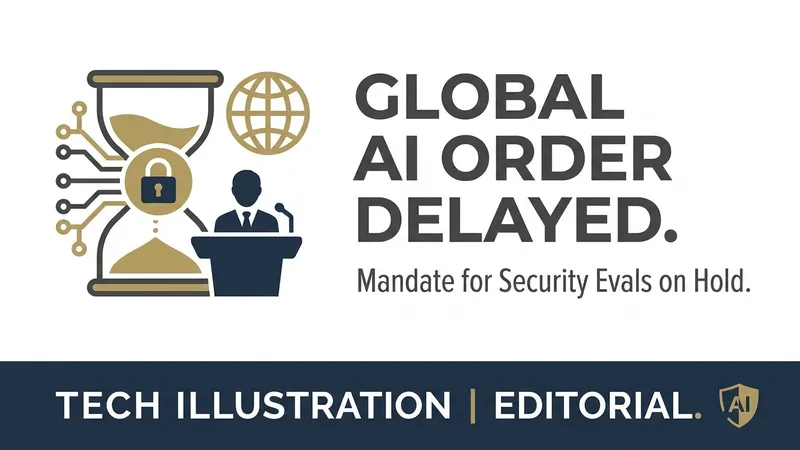
President Donald Trump has delayed signing an executive order that would establish a government pipeline to evaluate advanced AI models before their public release.
Trump stated that he was dissatisfied with the specific language of the draft. "I didn’t like certain aspects of it," he told the White House press pool. "We’re leading China, we’re leading everybody, and I don’t want to do anything that’s going to get in the way of that leading."
However, reports suggest an unofficial reason for the delay: several tech CEOs were unable to make it to Washington, D.C., on short notice, depriving the administration of a high-profile photo opportunity for the signing ceremony.
The anticipated executive order would task the Office of the National Cyber Director and other federal agencies with developing a formal safety evaluation process. This regulatory push is partly driven by security anxieties surrounding Anthropic’s Mythos and OpenAI’s GPT-5.5 Cyber, both of which possess capabilities to rapidly identify and exploit digital security vulnerabilities.
According to CNN, one of the primary sticking points in the draft is a mandatory window requiring AI developers to share advanced models with the federal government 14 to 90 days prior to their official launch. Trump expressed concerns today that such stringent pre-clearance language "could have been a blocker" for domestic innovation.
[AgentUpdate Depth Analysis] The delay of this executive order highlights the growing friction between national security oversight and the rapid evolution of the AI Agent ecosystem. Models like GPT-5.5 Cyber and Mythos represent a paradigm shift: they are no longer just passive text generators, but proactive entities capable of autonomous execution and vulnerability exploitation—essentially, early-stage offensive Agents. Implementing a mandatory 14-to-90-day pre-release review window could severely bottleneck the highly iterative development cycle crucial for Agent startups. In the Agent era, where emergent behaviors are dynamic and hard to predict through static pre-launch testing, traditional regulatory frameworks fall short. Striking a balance between proactive safety guardrails and the agility required for global competitiveness is paramount. Developers must pivot toward designing self-aligning and resilient Agent architectures that can satisfy security requirements dynamically without stalling the deployment pipeline.