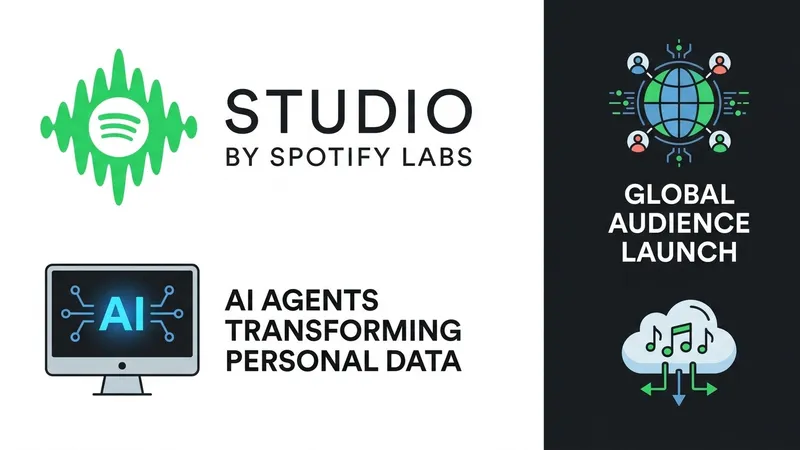
In the age of AI, connecting services like email, calendar, documents, and notes to create daily text or audio briefings has become a standard product play. Spotify is now leaping into this space with "Studio by Spotify Labs," a brand-new standalone desktop application designed to let users generate highly customized personal podcasts.
The app enables users to explore any given topic by turning it into an interactive podcast. What sets it apart is the addition of deep personal context. Driven by a built-in AI agent capable of browsing the web and fetching user-specific information, the app seamlessly synthesizes various data points into a tailored audio format.
For example, users can trigger multi-step, contextual prompts: "Create a daily audio brief for my road trip through Italy. Walk me through my day using my calendar and bookings, recommend a memorable dinner spot near where I'll be, and end with a podcast recommendation I'd love for the drive." The agent handles the web search, coordinates with schedule data, and outputs a structured podcast.
Privacy is central to this experience. All AI-generated podcasts are strictly private, synced across devices, and saved in the user's personal Spotify library rather than published publicly. Spotify has cautioned that the app is in its early research preview, meaning the underlying AI models are still prone to errors and hallucinations.
The desktop app is currently launching in research preview across more than 20 markets, available to select users aged 18 and older.
With this launch, Spotify is directly taking on Google’s NotebookLM, which popularized source-based podcast generation. Google later expanded this with Discover-based audio briefs, and the format has since been embraced by giants like Adobe and ElevenLabs, as well as startups like Hero and Huxe. Interestingly, Spotify’s desktop release follows a recent command-line tool designed for developers using Claude Code or Codex to generate personal podcasts. Studio now democratizes this capability for non-technical users.
Ultimately, this launch showcases Spotify’s ambition to control all things audio. The desktop footprint could allow Spotify to capture system audio in the future, pivoting into a meeting-notetaker space currently occupied by startups like Rewind, Cluely, and Granola.
[AgentUpdate Depth Analysis] Spotify's launch of Studio represents a pivotal shift from static document synthesis, popularized by Google’s NotebookLM, to dynamic, active personal AI Agents. By combining real-time web browsing with highly sensitive private data integrations (calendars, emails, bookings), Spotify is pioneering a new class of "Audio-Native Agents." This highlights how AI Agents are moving from chat-based assistants to ambient intelligence interfaces that consume multi-source raw data and synthesize it into highly polished, customized audio streams. From an ecosystem perspective, Spotify's move is a strategic play to own the audio-based personal dashboard. As these agents gain OS-level system audio capture capabilities, Spotify could evolve from a content streaming giant into an essential productivity hub, demonstrating how AI Agents can unlock massive new value by turning private, fragmented personal data into actionable, premium-quality personal media.