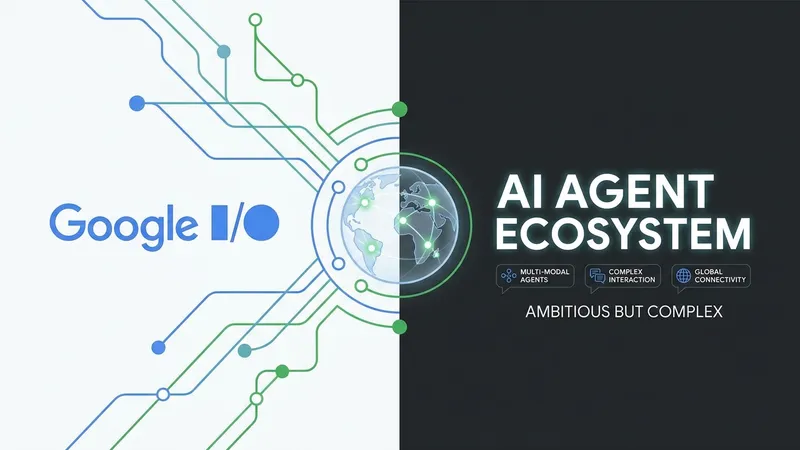
One of the most promising introductions at Google’s I/O developer conference on Tuesday was a new way for consumers to use the web: AI agents. Unfortunately, it was also the most confusing.
Google took the wraps off information agents, a reinvention of the aging Google Alerts service, now infused with AI. These AI agents are designed to operate in the background 24/7, helping users stay up to date on topics they’re interested in, like market trends, price tracking, or inclement weather warnings.
Then there is Gemini Spark, a "personal" AI agent that can help you navigate your digital life by integrating with Google products, like Gmail, Google Docs, and Google Workspace. The company says the assistant can handle everyday tasks like surfacing themes from newsletters, organizing your home inventory, and keeping track of what needs restocking, or helping you plan and manage a group trip with friends.
Or, as Google showed off in a very engineering-minded example, you could use it to organize a neighborhood block party — as if that would require any management beyond a group chat or some emails.
There’s also a name for how you track notifications from Spark: Android Halo. Why an Android feature needs its own brand is baffling, but a good guess is that Google’s internal product teams are fairly competitive and want to highlight their own work, even at the risk of confusing users.
Next, Gemini’s app is getting an AI agent that can compile a personalized digest from your Gmail inbox, calendar, and tasks, and provide an update called Daily Brief.
Many of these products have not yet shipped, or at least won’t be available to the wider public right away. Instead, Google is targeting its heavier users for now: the subscribers of its new, $100-per-month Google Ultra plan.
Google Pro and Ultra subscribers in the U.S. will get to use information agents starting this summer, and Spark will be available to Ultra subscribers "soon." Halo will ship to Android users "later this year." Daily Brief is rolling out in the U.S. to Ultra, Pro, and Plus subscribers.
As a result of all these launches, we’ll soon have so many entry points for using AI agents that it may be overwhelming as to where to start. We also saw an increasingly agentic Chrome web browser, where Google showed off how you could talk to Chrome while shopping for cars online to configure options without clicking around.
In a press briefing ahead of I/O, Google said it intends to bring its agentic features, including Spark, to free users "when the time is right." But for the time being, the company’s more interested in iterating with a group of people, like the Ultra subscribers, who will push the limits of what Spark and AI agents can do.
[AgentUpdate Depth Analysis] Google's strategy of gating its advanced AI agents behind a hefty $100/month Ultra tier represents a significant paradigm shift, treating agentic workflows as premium SaaS upsells rather than utility layers. While Google commands massive distribution advantages through Workspace and Android, this pricing model and fragmented branding (Spark, Halo, Information Agents) create high cognitive and financial barriers. In contrast, the broader AI Agent ecosystem is gravitating toward lightweight integration standards, such as Anthropic's Model Context Protocol (MCP). By confining high-tier reasoning and proactive workflows to an elite user base, Google risks slowing down the collaborative feedback loops necessary to refine consumer agents. This fragmentation leaves an immense market opportunity for agile, open-source alternatives and cross-platform browser agents to capture mainstream consumer adoption by offering seamless, affordable agentic capabilities.