As AI Agents evolve, developers are empowering Large Language Models (LLMs) with an increasingly diverse array of tools and skills. However, this expansion comes with a major engineering bottleneck: prompt bloat. In traditional Agent architectures, to enable models like Claude or GPT-4 to call custom tools or Model Context Protocol (MCP) services at any time, developers typically inject the entire schema of all available tools into the context window for every single user request.
This 'all-in-one' approach quickly consumes precious tokens as the toolchain grows. For instance, a comprehensive catalog containing dozens of code manipulation, file system, and database tools can easily take up tens of thousands of tokens. Every time a user initiates a simple query, they pay a hefty 'token tax' for tool definitions that are never even invoked, resulting in high latency and skyrocketing API costs.
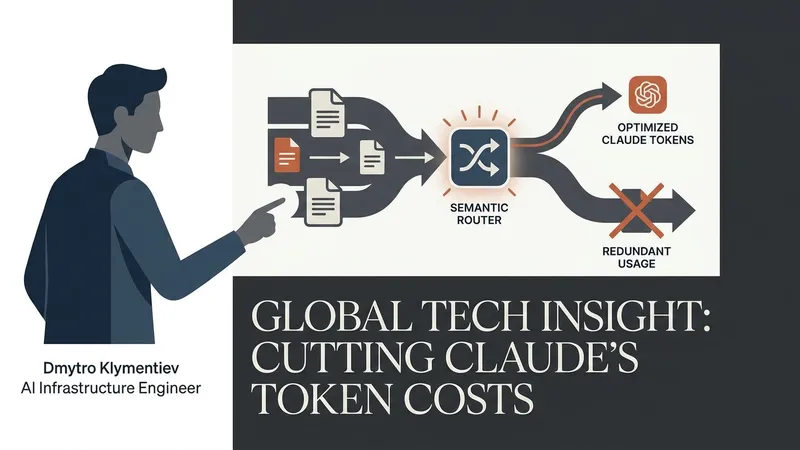
To solve this, AI infrastructure engineer Dmytro Klymentiev has demonstrated a game-changing optimization: utilizing a Semantic Router. The core mechanism is straightforward yet powerful. Instead of passing the entire skill catalog to the LLM, a lightweight embedding model or local classifier intercepts the user's query first. It performs a vector similarity search to predict which tools are relevant to the user's intent, and then dynamically injects only those 1 or 2 specific tool schemas into Claude's prompt.
In a test environment with a large catalog of code editing skills, routing the queries semantically allowed the system to identify the exact tools needed (such as `read_file` or `patch_code`) and ignore the rest. The results were staggering: semantic routing cut the tool-related token usage by 456x.
Beyond cost reduction, this engineering pattern drastically improves the reliability of tool calling. When an LLM's context window is cluttered with irrelevant schemas, it suffers from distraction and 'lost in the middle' phenomena, leading to hallucinated arguments or incorrect tool execution. By serving Claude a highly refined, relevant set of tools, developers ensure near-perfect execution accuracy while keeping latency minimal.
[AgentUpdate Depth Analysis] The application of Semantic Routers represents a critical transition in AI engineering from brute-force prompting to intelligent orchestration. As the Model Context Protocol (MCP) gains traction and the number of tools available to Agents scales to the thousands, static tool injection becomes completely untenable. Semantic routing acts as an essential 'semantic gateway,' decoupling tool catalog complexity from LLM context constraints. By shifting the heavy lifting of intent-matching to ultra-fast, cost-effective embedding models, we can keep the cognitive load of frontier models like Claude highly focused. This design pattern is a prerequisite for building production-grade, low-latency, and cost-efficient Multi-Agent systems that can scale seamlessly without breaking the bank.