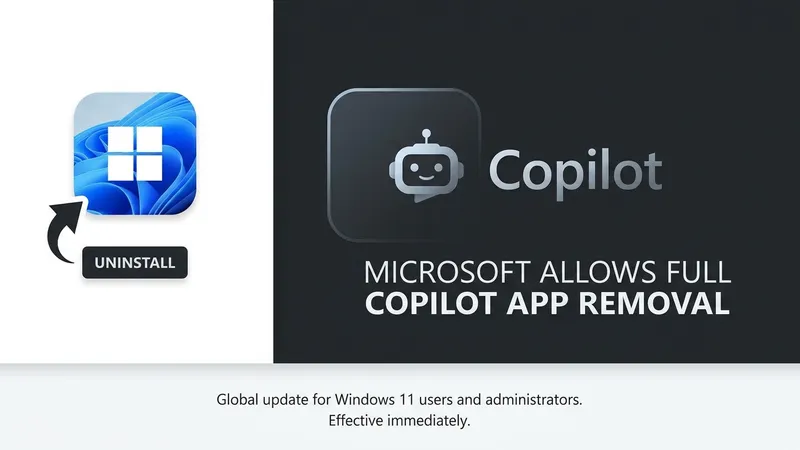
Microsoft’s April 2026 update will allow users and IT administrators to fully uninstall the Copilot app from Windows 11. This pivotal move follows low adoption metrics, with only 3.3 percent of eligible users paying for Copilot, alongside persistent user backlash regarding Microsoft's forced push of AI features without granular user control.
The change applies to both enterprise administrators using Group Policy and home/Pro users, who can now uninstall the app through Settings like any other standard application. For IT administrators, the new policy is named “Remove Microsoft Copilot app” and can be found under User Configuration -> Administrative Templates -> Windows Components -> Windows AI in the Group Policy Editor. Administrators can also execute this via the Windows Registry. However, the policy will trigger an automatic uninstallation only if specific conditions are met: both Microsoft 365 Copilot and the standalone Microsoft Copilot must be installed, the user must not have manually installed the app, and the app must not have been launched in the past 28 days.
For home and Pro users, the uninstallation path is straightforward: navigate to Settings -> Apps -> Installed Apps, search for Copilot, and select Uninstall. The app can be easily reinstalled later from the Microsoft Store if required.
This transition marks a significant concession for Microsoft. Since integrating Copilot deeply across Windows 11 and Microsoft 365 in 2023, the tech giant heavily promoted the tool as its flagship AI offering, embedding it by default into the taskbar, Edge, Notepad, Office, and Outlook. Previously, users wanting to remove Copilot had to rely on complex PowerShell scripts, registry hacks, or third-party debloating utilities. The April update marks the first time Microsoft provides an official, fully supported path for removal.
The timing points to a broader challenge regarding monetization and user utility. Out of approximately 450 million Microsoft 365 seats with access to Copilot Chat, only 15 million (3.3%) are active, paying subscribers. Such a conversion rate suggests that users either do not perceive sufficient value to justify the $30 per user monthly fee, or actively try to avoid it. Compounding this is Microsoft’s own terms of service, which describe Copilot as being “for entertainment purposes only”—a disclosure that clashes with its positioning as an enterprise productivity powerhouse.
This move aligns with a broader Windows 11 optimization strategy, where Microsoft is pruning legacy features like WordPad (deprecated in 2024), the Tips app, and Cortana. Giving users the option to remove Copilot is a logical continuation of this philosophy: forcing unused features onto users ultimately breeds resentment.
[AgentUpdate Depth Analysis] Microsoft’s decision to make Copilot optional marks the end of the "forced integration" era in consumer AI. For the past two years, tech giants have rushed to hard-code embryonic AI features into every layer of software, resulting in user friction and immense infrastructure costs without proportional value creation. In the evolving AI Agent ecosystem, success will not stem from OS-level bundling but from an Agent's organic ability to solve complex, multi-step workflows. By stepping back, Microsoft implicitly opens up market space for modular, light-weight, and context-aware Agents built on open standards like the Model Context Protocol (MCP). The future belongs to decentralized, user-consented Agentic tools that integrate seamlessly on-demand, rather than bloated, always-on default system assistants.