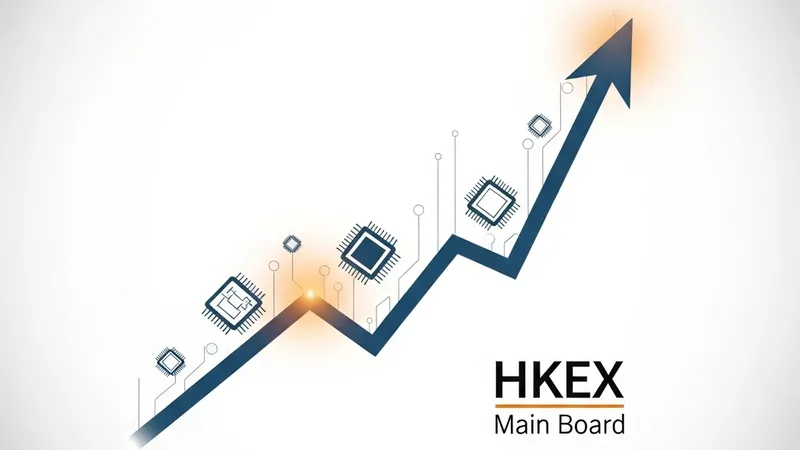
Hong Kong-listed Chinese semiconductor stocks rallied significantly as market optimism swelled over potential technological breakthroughs from technology giant Huawei. Industry leaders, including Semiconductor Manufacturing International Corp (SMIC) and Hua Hong Semiconductor, witnessed substantial share price increases. Investors are heavily betting on Huawei's latest advancements in self-developed AI processors and advanced packaging technologies to bypass trade restrictions and accelerate domestic supply chain autonomy.
Sources indicate that Huawei is making concrete progress on its next-generation Ascend AI silicon, aiming to deliver compute capabilities that rival global benchmarks. To address the surging domestic demand for AI infrastructure, Huawei has been deeply collaborating with local foundries and OSAT (Outsourced Semiconductor Assembly and Test) providers to optimize domestic production lines. This aggressive decoupling strategy has not only secured AI hardware supply chains but also funneled massive orders into domestic semiconductor ecosystems.
Market analysts note that as large language models transition toward multimodal capabilities and autonomous Agent systems, the construction of sovereign AI infrastructure has become a paramount strategy. The stock rally reflects strong market confidence in China's silicon self-sufficiency. Despite lithography constraints, domestic chipmakers are leveraging system-in-package (SiP) innovations and software-hardware co-design to deliver resilient performance.
[AgentUpdate Depth Analysis] Huawei's progress in AI silicon serves as a critical foundation for the localized AI Agent ecosystem. Next-generation AI Agents demand highly cost-effective and low-latency computation, which is heavily bottlenecked by hardware availability. By tightly coupling its Ascend processors with the CANN computing architecture, Huawei is forging an independent, end-to-end stack alternative to Nvidia's CUDA. While software compatibility remains a challenge, this hardware breakthrough drastically lowers the capital expenditure for Chinese enterprises deploying localized, secure, and multi-agent systems. In the long run, this sovereign hardware foundation will accelerate the proliferation of industrial-grade AI Agents across sensitive sectors like finance, government, and manufacturing, fostering a unique and self-sustaining AI ecosystem.