Large language models (LLMs) have become the default interface for developer workflows ranging from code generation and math problem solving to document summarization. Under the hood, however, most LLMs still generate text autoregressively: one token at a time, where each token depends on the preceding ones.
While this autoregressive (AR) approach is stable and simple to serve, it imposes a hard physical limit. Every new token requires a full model pass, forcing weights to be loaded from memory before computation starts. For latency-sensitive applications or developers running smaller batch sizes, token-by-token generation leaves significant GPU performance on the table, as most GPU time is spent on memory operations rather than computation. Additionally, once an AR model generates a token, it cannot revise it, causing mistakes to propagate throughout the output.
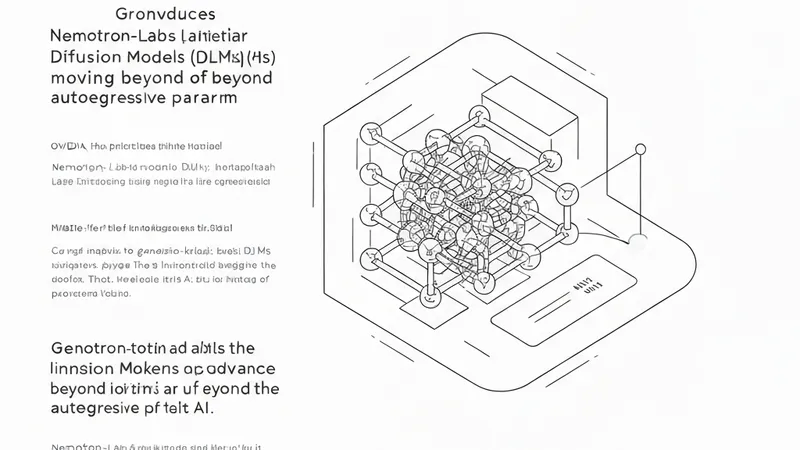
NVIDIA Nemotron-Labs Diffusion introduces a new path forward: diffusion language models (DLM) that generate multiple tokens in parallel and iteratively refine them. This generate-and-refine paradigm leverages modern GPU compute more efficiently, natively supports text revision and fill-in-the-middle tasks, and provides an adjustable inference budget by scaling refinement steps at runtime.
The Nemotron-Labs Diffusion family includes text models at 3B, 8B, and 14B scales under the commercially-friendly NVIDIA Nemotron Open Model License, alongside an 8B vision-language model (VLM). NVIDIA has released the weights, training code via the NVIDIA Megatron Bridge framework, and inference recipes integrated with SGLang for high-performance serving.
[AgentUpdate Depth Analysis] The shift from autoregressive to diffusion-based language modeling marks a pivotal evolution for the AI Agent ecosystem. For autonomous agents, error propagation has historically been a fatal flaw, where a single incorrect token derails the entire execution chain. Nemotron’s parallel-generation and refinement paradigm introduces native revision and self-correction capabilities, acting as a cognitive buffer for agents. Furthermore, multi-agent collaboration and tool-calling demand extremely low latency. By parallelizing token generation and allowing dynamic inference budgets, DLMs can drastically reduce agent round-trip times. Coupled with SGLang for high-throughput serving, this technology lays the foundation for highly responsive, self-correcting, and cost-optimized agentic workflows.