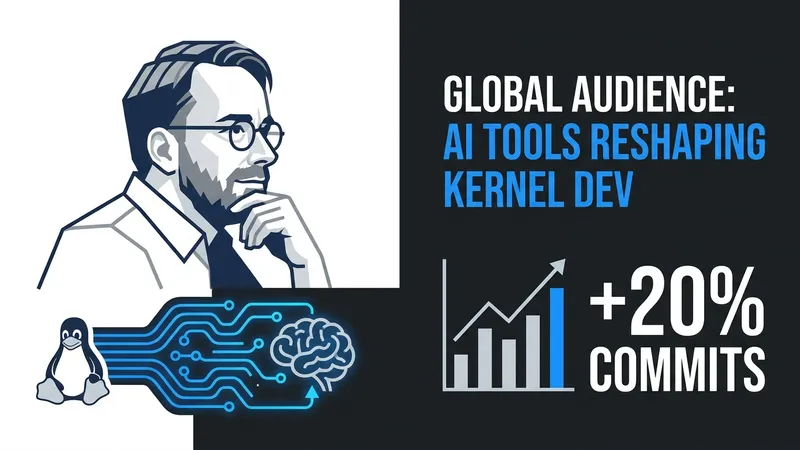
At the recent Open Source Summit North America, Linux creator Linus Torvalds shared his candid perspective on Artificial Intelligence, stating that while AI tools are actively reshaping kernel development, they remain a helpful tool rather than a replacement for human programmers.
Torvalds revealed that code commits for the last two kernel releases spiked by 20%. While he initially attributed the surge to developer excitement over the major version jump from 6.x to 7.x, he later discovered the actual catalyst was the rapid advancement of AI-assisted programming tools over the past six months. He admitted that AI has significantly lowered the entry barrier for new contributors.
However, Torvalds argued that AI's primary impact so far is social rather than technical. As a prime example, security mailing lists have recently been inundated with duplicative and low-quality bug reports generated by AI tools. To mitigate this influx of automated noise, the kernel team had to establish new filtering rules.
Addressing security, Torvalds urged security researchers not to disclose exploits prematurely. He noted that four recent privilege escalation vulnerabilities were publicly disclosed by researchers looking for attention before the kernel maintainers were even notified. Furthermore, he dismissed the idea that closed-source software is more secure, arguing that closed-source is actually worse because AI tools cannot effectively assist in patching bugs without access to the underlying source code.
Ultimately, Torvalds emphasized that maintaining a massive project like Linux relies on human collaboration rather than raw code. As the top maintainer, his job is about managing people, and he stated he would not use AI to communicate with others, advising others to do the same. Reflecting on his career—from manually entering machine code, to using assemblers, compilers, and now AI—he views AI as a natural evolution of developer tooling. It changes how we write code, but not the essence of programming. Developers must still understand what the tools generate to ensure long-term system maintainability.
[AgentUpdate Depth Analysis] Linus Torvalds' critique highlights a critical bottleneck in the current AI Agent ecosystem: the tension between automated productivity and social collaboration. While AI assistants like Cursor and GitHub Copilot have successfully driven a 20% surge in code generation, they also generate noise, such as low-quality automated bug reports that strain human-maintainer workflows. This underscores that the future of Software Engineering Agents lies not just in writing raw code, but in contextual understanding, noise filtering, and adherence to community norms. For AI Agents to truly mature within complex, open-source systems like Linux, they must evolve from simple code-generators into collaborative, "trust-aware" entities that respect human-in-the-loop workflows rather than trying to automate away human consensus.