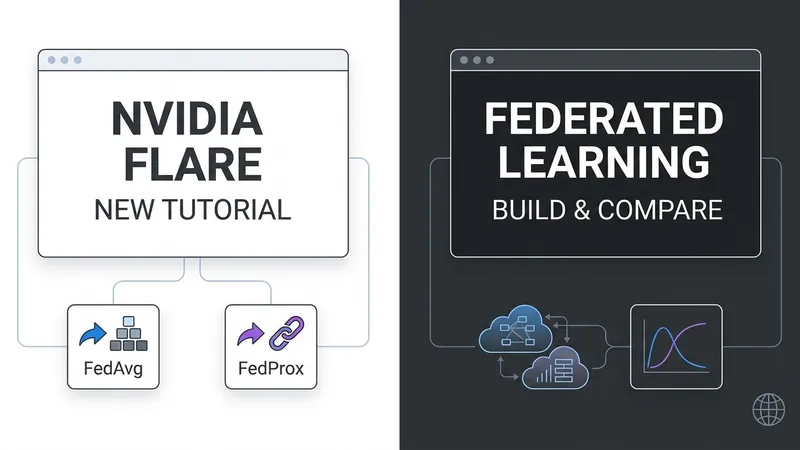
In real-world federated learning (FL), the non-IID (non-independently and identically distributed) nature of client data poses a major challenge to model convergence. In this tutorial, we construct an advanced federated learning experiment using NVIDIA FLARE to compare the performance of FedAvg and FedProx on a non-IID CIFAR-10 setup.
To simulate realistic label imbalance (Label Skew) across 3 clients, we partition the dataset using a Dirichlet distribution with an alpha of 0.3. The experiment utilizes NVFlare's Job API to orchestrate the global pipeline, while the Client API manages localized client training, model synchronization, and client-server communications.
After installing the required libraries (including nvflare>=2.5, torch, and matplotlib), we initialize global configuration parameters like batch size, local epochs, learning rate, and the alpha value, downloading CIFAR-10 locally so that simulated sites can safely access the shared partition:
!pip install -q "nvflare>=2.5" torch torchvision matplotlibThe client-side training script includes a simple, batchnorm-free CNN architecture and a deterministic Dirichlet partition utility. By sharing the same seed, virtual client processes independently agree on identical dataset splits, avoiding simulation sync issues.
By running both FedAvg and FedProx on the exact same dataset splits, we observe how FedProx handles extreme statistical heterogeneity more gracefully. By incorporating a proximal term to penalize local updates drifting too far from the global server model, FedProx guarantees superior stability and faster convergence.
[AgentUpdate Depth Analysis] Federated learning is evolving into a foundational infrastructure for secure Multi-Agent Systems. In privacy-critical AI Agent deployments (e.g., enterprise operations or clinical health agents), individual agents are often hindered by localized "data silos." Utilizing platforms like NVIDIA FLARE, heterogeneous agents can collaborative-train and align their capabilities without exposing raw user logs or proprietary datasets. FedProx’s proximal restriction acts as a critical regularization layer, preventing specialized agents from experiencing catastrophic forgetting or behavioral drift. This paradigm shift—from isolated reasoning to federated agent learning—will catalyze the next-generation of secure, decentralized cooperative AI ecosystems.