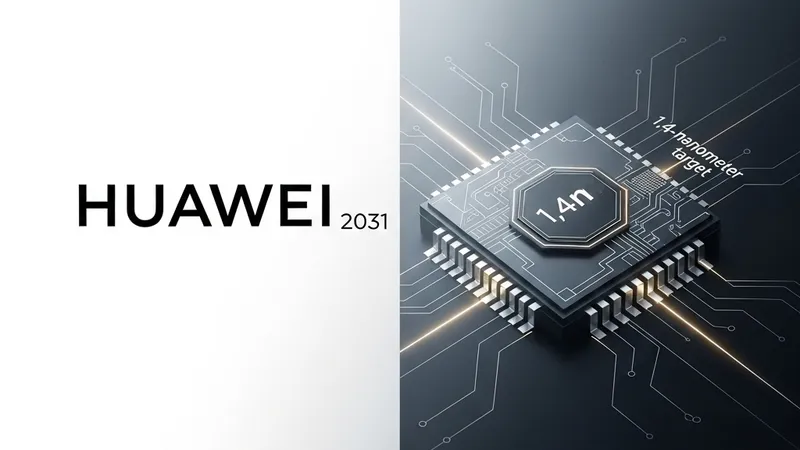
Huawei has made a bold claim that it can manufacture its own semiconductor chips that are just as competitive as global rivals, thanks to a new technical breakthrough. Speaking at a semiconductor symposium in Shanghai, the Chinese tech giant announced it will be able to produce chips with transistor densities matching the 1.4-nanometer (nm) processes that competitors like Taiwan Semiconductor Manufacturing Corp (TSMC) and Samsung are expected to deploy in the coming years.
If achieved, this development would represent a major milestone for Huawei, which has been subject to expanding US trade sanctions since 2019. These restrictions have severely limited Huawei's growth by blocking access to specialized equipment—such as Advanced Extreme Ultraviolet (EUV) lithography machines—that competitors rely on to achieve sub-2nm nodes. In contrast, TSMC has already scheduled its 1.4nm process to enter commercial production in 2028.
While Huawei's projected timeline puts it roughly three years behind the market leader, the company aims to offer a much more cost-effective solution. He Tingbo, the head of Huawei’s chip design division, stated that their proprietary process is both "feasible and affordable," according to a report by The Wall Street Journal. Currently, China's leading chipmaker, Semiconductor Manufacturing International Corp (SMIC), supplies Huawei with 7nm processors, which currently power the Mate 60 smartphone series.
[AgentUpdate Depth Analysis] Huawei's push toward cost-effective 1.4nm-class silicon is a pivotal signal for the future of the AI Agent ecosystem, particularly for on-device and edge intelligence. As AI Agents transition from centralized cloud API calls to localized, highly efficient continuous reasoning engines, hardware cost and energy efficiency become the ultimate battlegrounds. While 2031 puts Huawei behind TSMC's raw timeline, an "affordable and feasible" domestic semiconductor pipeline ensures that non-Western AI ecosystems can sustain high-density compute without relying on restricted global supply chains. This localized hardware sovereignty will heavily influence how agentic workflows, multi-modal local models, and real-time edge processing are distributed globally, effectively democratizing advanced Agent tech despite ongoing geopolitical fragmentation.