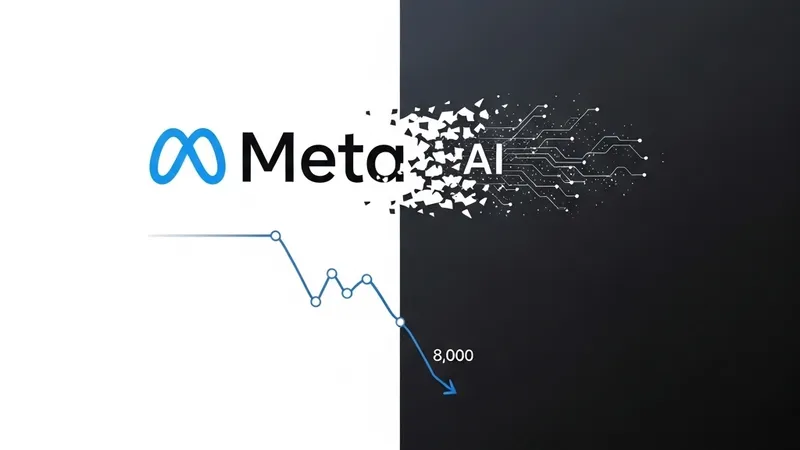
Meta is set to begin a new round of layoffs potentially impacting about 8,000 employees (roughly 10% of its workforce), with more job cuts expected later this year as the tech giant accelerates its pivot toward artificial intelligence, according to CNBC. The layoffs are scheduled to start on Wednesday, and the company has also scrapped plans to fill 6,000 open positions. Citing sources familiar with the matter, more redundancies could take place in August and throughout the fall. Meta informed its workforce that the decision is "part of our continued effort to run the company more efficiently and to allow us to offset the other investments we're making."
Meta's CFO, Susan Li, stated during the Q1 earnings call that leadership doesn't "really know what the optimal size of the company will be in the future." Meta ended Q1 2026 with 77,900 employees, down 1% from the final quarter of 2025 following previous redundancy rounds. While past cuts were aimed at streamlining operations after massive metaverse spending, executives are now explicit that headcount is being directly traded for AI computing power. CEO Mark Zuckerberg noted, "we are seeing more and more examples where one or two people are building something in a week that would have previously taken dozens of people months."
However, this aggressive shift has sparked intense internal pushback. Employees are protesting Meta’s decision to implement a system that tracks mouse movements, keystrokes, and takes screen snapshots to train its AI models. According to Reuters, staff are distributing flyers across U.S. offices urging colleagues to sign an online petition protesting the tool, asking, "Don't want to work at the Employee Data Extraction Factory?"
The petition claims that leadership failed to provide completed privacy reviews—such as mandated 'people data reviews'—for processing employee data. "The outlined privacy mitigations were vague, and leadership's confidence in them appeared limited—evidenced by the selective opt-out afforded to executives," the petition states. Employees emphasized that collecting and repurposing this granular workplace data raises profound concerns regarding privacy, consent, and mutual trust.
Introduced in late April as the "Model Capability Initiative" (MCI), the tool takes screenshots of employee screens. A Staff AI research scientist noted in a company memo that the objective is to improve Meta’s foundation AI models in areas where they struggle to replicate the nuanced ways humans interact with computer operating systems.
[AgentUpdate Depth Analysis] Meta's controversial "Model Capability Initiative" (MCI) highlights the massive data bottleneck currently facing the AI Agent ecosystem. To build capable GUI-based or "Computer Use" Agents, foundation models require massive datasets of high-fidelity human-computer interaction (HCI) trajectories—precisely the mouse movements, keystrokes, and screen transitions Meta is tracking. By leveraging its own workforce's daily workflows, Meta is seeking a proprietary shortcut to train highly sophisticated AI Agents capable of executing complex multi-step digital tasks. However, this strategy sparks a significant ethical dilemma, effectively turning employees into data generators for the very AI systems designed to replace them. For the broader AI Agent landscape, while this demonstrates that real-world workplace data is the ultimate fuel for next-generation digital workers, it also signals that the race for Agent capabilities will increasingly clash with workplace privacy, consent, and compliance standards globally.