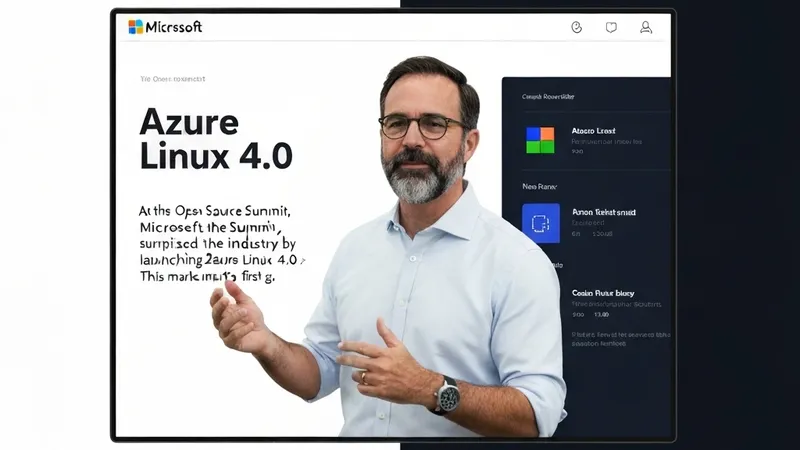
At the Open Source Summit North America, Brendan Burns, co-founder of Kubernetes and Microsoft's corporate vice president of Azure Cloud Native, dropped a major bombshell. During his presentation on the evolution from open source to agentic AI, Burns announced the release of Microsoft's first supported, general-purpose open-source Linux distribution available on Azure: Azure Linux 4.0. The unexpected announcement caught both the audience and Linux Foundation CEO Jim Zemlin by surprise.
While Microsoft has previously released Linux-based software—such as the Azure Sphere IoT platform and CBL-Mariner (a container platform later renamed Azure Linux)—it has never before shipped a full, general-purpose Linux distribution. This release effectively solidifies Microsoft's transition to a de facto Linux-based cloud giant, a far cry from the era when former CEO Steve Ballmer infamously branded Linux as 'a cancer.' Today, Linux is the dominant operating system running on Azure.
The surprise announcement was originally slated for Microsoft Build but was moved up. Lachlan Evenson, Microsoft's principal program manager on Azure's open-source team, confirmed that Azure Linux 4.0 represents Microsoft's push to turn the platform into a full-fledged cloud distribution. Simultaneously, Microsoft is productizing Flatcar Container Linux as a hardened, immutable container host (Azure Container Linux), offering enterprises a highly secure and minimal footprint optimized for intense cloud-native and AI workloads.
[AgentUpdate Depth Analysis] As AI Agents transition from isolated experimental tools to massive, enterprise-grade autonomous swarms, the requirements for underlying infrastructure are undergoing a paradigm shift. With Azure Linux 4.0, Microsoft is laying the groundwork for an 'Agent-Native' cloud. The execution of sophisticated AI Agents demands microsecond-level scheduling, rigorous sandbox security, and minimal overhead. By integrating a highly secure, immutable host like Flatcar into Azure Linux, Microsoft directly addresses the critical security risks of dynamic code execution inherent in AI Agents. Unlike bloated legacy operating systems, this ultra-lean, secure cloud-native Linux distribution is poised to become the standard runtime environment for millions of autonomous Agents, demonstrating that tech giants are already rebuilding the AI ecosystem from the operating system level up.