At a semiconductor industry conference in Shanghai, Huawei announced a new chip design approach, claiming it could help the company achieve cutting-edge semiconductor performance within five years. This marks a notable development in China's push for technological self-reliance amid ongoing US export restrictions.
Huawei described a shift away from traditional transistor miniaturization toward a stacked architecture, designed to bypass reliance on extreme ultraviolet (EUV) lithography equipment, which remains restricted under US sanctions introduced in 2019. The company framed this development as part of a broader effort to strengthen China's domestic semiconductor supply chain in response to Washington's technology controls.
Huawei stated that its future Kirin processors would aim for transistor density equivalent to 1.4-nanometer class processes by 2031. This places its long-term roadmap in line with next-generation targets set by leading global chipmakers. Taiwan Semiconductor Manufacturing Company (TSMC) has indicated it expects to begin 1.4-nanometer production in the coming years, while China's most advanced domestic manufacturing capability is currently estimated at around the 7-nanometer level.
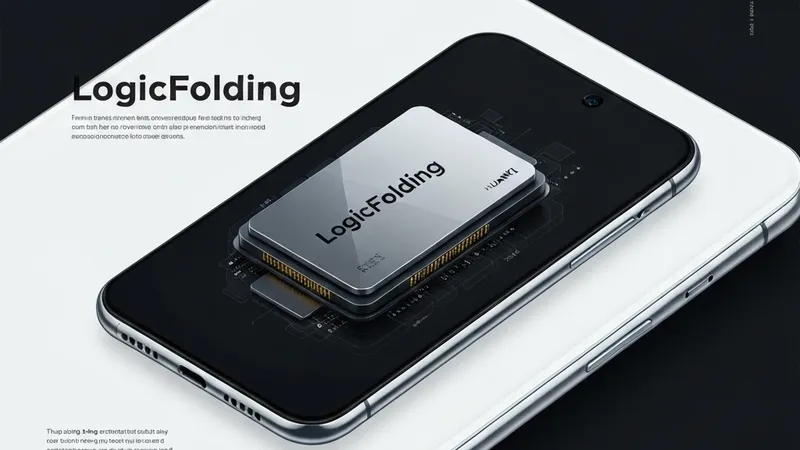
Huawei's semiconductor division outlined a design method called "LogicFolding," which restructures chip architecture into vertically stacked layers rather than solely relying on shrinking transistor size. The company also introduced a framework referred to as the "Tau Scaling Law," focusing on reducing data travel time within chips through three-dimensional design approaches. Huawei positioned this concept as an alternative to Moore's Law, which has guided semiconductor advancement for decades but is widely viewed as approaching physical and economic limits.
This announcement comes at a time of heightened strategic competition between Washington and Beijing over advanced computing technologies, including semiconductors and artificial intelligence systems. The United States has tightened export controls on chip design software, manufacturing tools, and advanced semiconductor equipment, while China has increased state-backed investment into domestic chip development as part of its broader industrial policy.
Industry analysts have noted that while architectural innovation may improve efficiency, manufacturing constraints remain significant. Issues including thermal management, system integration, and production scalability continue to challenge efforts to match leading-edge global fabrication capabilities.
Huawei's push in semiconductors follows earlier milestones that kept the company in focus despite sanctions, including the 2023 launch of its Mate 60 smartphone series featuring domestically produced 5G chips.