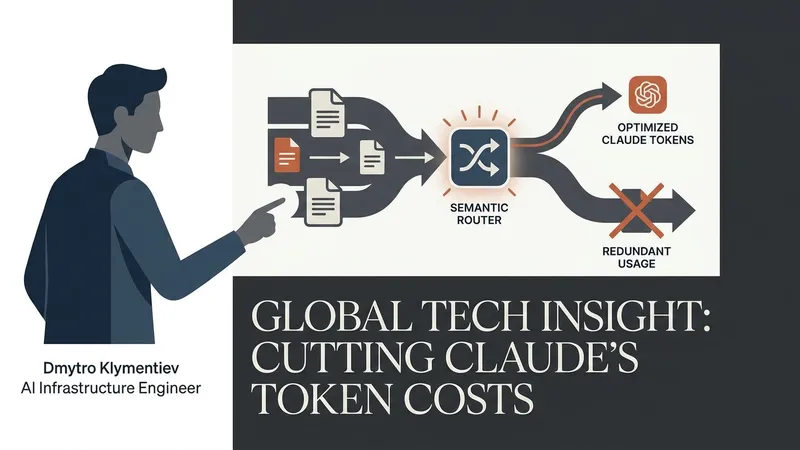
AI infrastructure engineer Dmytro Klymentiev recently unveiled a compelling study demonstrating that semantic routers can drastically reduce the token consumption of large language models like Claude when handling code-related skills by an impressive 456 times. This innovation marks a significant leap in efficiency and cost-effectiveness for developing AI agents and multi-agent systems.
In contemporary AI application development, powerful LLMs such as Claude often demand extensive context windows for complex, context-sensitive tasks, especially in code understanding, generation, and debugging. This leads to substantial token usage, incurring high operational costs and potential latency. The fundamental principle of semantic routers is to bypass sending every user request directly to a large, general-purpose LLM. Instead, it employs embedding technology to deeply analyze and comprehend user intent.
Specifically, upon receiving a user request, the semantic router converts it into vector embeddings. These embeddings are then compared against a pre-defined "skill catalog" containing embeddings for various code-specific skills. By computing semantic similarity, the router intelligently identifies the most appropriate code skill aligned with the user's intent and precisely routes the request to a smaller, more specialized model or tool tailored for that skill. For instance, a request concerning Python code optimization would be directed to a module specifically designed for that task, rather than engaging a vast, general code generation model.
This intelligent routing mechanism profoundly optimizes context window utilization. As each request is channeled only to the minimal necessary context and the most relevant tools, the LLM avoids processing superfluous information, leading to a dramatic reduction in token calls. Klymentiev's findings indicate that this approach achieves up to a 456x token reduction in Claude's code skill scenarios, not only slashing API costs but also enhancing response speed and overall system efficiency. This is critically important for building economical and high-performing multi-agent systems and AI agents, particularly in environments requiring frequent interactions and complex logical processing, such as a Multi-Agent Collaboration Platform (MCP) server environment.
This technological advancement offers AI developers a more refined and efficient strategy for managing LLM resources, signifying a major step forward in the practicality and scalability of AI agent systems.