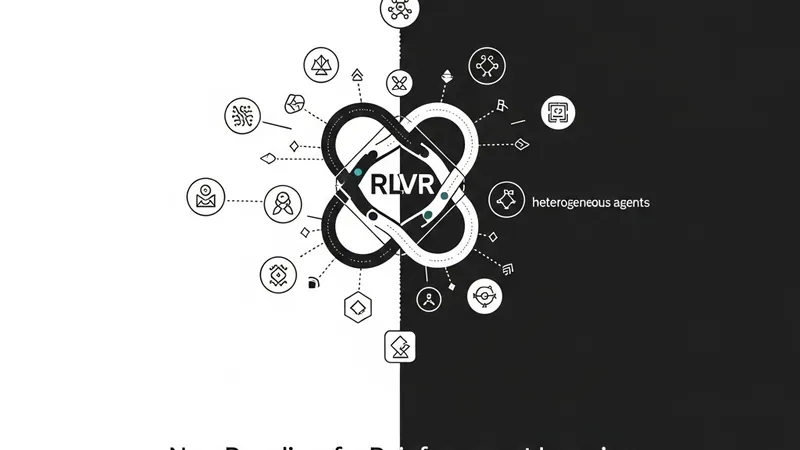
In a newly published research paper, researchers have introduced Heterogeneous Agent Collaborative Reinforcement Learning (HACRL), a novel Reinforcement Learning from Verifiable Reward (RLVR) paradigm that targets the inefficiencies of isolated multi-agent on-policy optimization. HACRL enables collaborative optimization during training while preserving independent execution during inference, offering a breakthrough for scaling diverse AI Agent ecosystems.
Unlike LLM-based multi-agent reinforcement learning (MARL), which demands tightly coupled and coordinated deployments at inference time, HACRL allows heterogeneous agents—possessing distinct architectures and scales—to share verified rollouts during training for mutual improvement, without requiring joint deployment afterwards. Furthermore, unlike traditional on- or off-policy knowledge distillation, which relies on a unidirectional teacher-to-student transfer, HACRL facilitates bidirectional, peer-to-peer learning between diverse agents.
Building on this framework, the authors propose HACPO (Heterogeneous Agent Collaborative Policy Optimization). To address critical challenges such as capability discrepancies and policy distribution shifts among disparate models, HACPO incorporates four customized mechanisms with solid theoretical guarantees on unbiased advantage estimation. This mathematical rigor ensures stable and sample-efficient joint policy optimization.
Extensive evaluations across various heterogeneous model configurations and reasoning benchmarks demonstrate that HACPO consistently improves all participating agents. Crucially, HACPO outperforms the GSPO baseline (even when GSPO is granted double rollouts) by an average of 3.6%, while requiring only half of the rollout generation budget. This showcases remarkable sample efficiency and practical viability for complex agentic workflows.
[AgentUpdate Depth Analysis] HACRL represents a landmark shift from isolated agent tuning to collective swarm optimization. Historically, the AI Agent ecosystem has been polarized between deploying heavyweight, cost-prohibitive LLMs and lightweight but underperforming localized models. By establishing a "train collaboratively, run independently" paradigm, HACRL bridges this chasm. It enables smaller edge agents to absorb the reasoning rigor of larger models during training, while simultaneously allowing larger models to benefit from the diverse exploratory trajectories of specialized agents. This bidirectional optimization bypasses the high latency and infrastructure overhead of multi-agent orchestration during runtime. As we advance toward decentralized Agent swarms, HACRL's ability to democratize high-quality reinforcement learning across heterogeneous hardware budgets will be a critical catalyst for low-cost, high-performance edge Agent deployments.