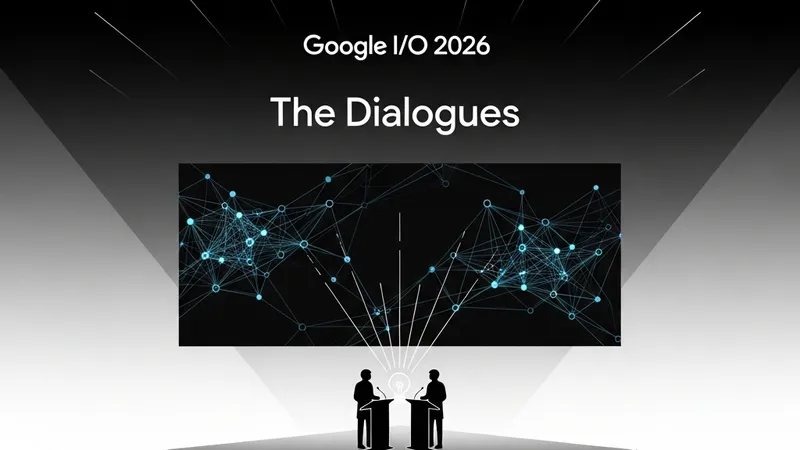
At Google I/O 2026, the Dialogues stage emerged as a hub for deep-tech exploration, bringing together Google leaders, prominent scientific minds, and creative visionaries to unpack the technological breakthroughs shaping our society and future. Here are the key highlights from the sessions:
Beyond the Keynote: Google CEO Sundar Pichai sat down with Matt Berman, Creator and Founder of Future Forward, to unpack the long-term vision behind the biggest announcements of I/O 2026 and how they translate to future product paradigms.
AI Agents: Google’s Josh Woodward, Koray Kavukcuoglu, Liz Reid, and Jeff Dean joined host Logan Kilpatrick to discuss how "proactive AI agents" are set to fundamentally transform human productivity, moving from reactive chatbots to proactive workflow orchestrators.
Quantum & AI: Google’s Hartmut Neven and James Manyika explored the promising intersection of quantum computing and AI, highlighting how quantum acceleration could unlock new paradigms for machine learning architectures.
Science: Google DeepMind CEO Demis Hassabis sat down with Axios’ Mike Allen to showcase AI’s pivotal role in accelerating scientific discoveries, drug development, and solving complex global challenges.
Robotics: Google DeepMind’s Kanishka Rao and Boston Dynamics’ Alberto Rodriguez, alongside Jacklyn Dallas from NothingButTech, discussed the massive leap in embodied physical AI, bridging the gap between digital reasoning and physical action.
Creativity: Acclaimed Director Doug Liman, along with 30 Ninjas’ Jed Weintrob and Julina Tatlock, joined Google's Mira Lane to examine the creative boundaries being pushed by AI in modern cinematic storytelling.
[AgentUpdate Depth Analysis] The discussions at Google I/O 2026 signal a major paradigm shift: Google is actively steering the AI Agent ecosystem toward "proactivity" and "physical embodiment." While competitors like OpenAI and Anthropic focus heavily on desktop productivity tools, Google’s strategy uniquely bridges DeepMind’s decision-making algorithms with physical systems (evidenced by the collaboration with Boston Dynamics). By integrating proactive agent workflows with embodied robotics, Google is aiming to solve real-world physical coordination problems. This highlights a future where AI Agents are no longer confined to browser-based APIs, but are instead integrated into systemic, multi-modal environments. For the global developer and enterprise landscape, this evolution demands a transition from simple prompt engineering to complex, reactive-proactive system orchestration across both digital and physical touchpoints.