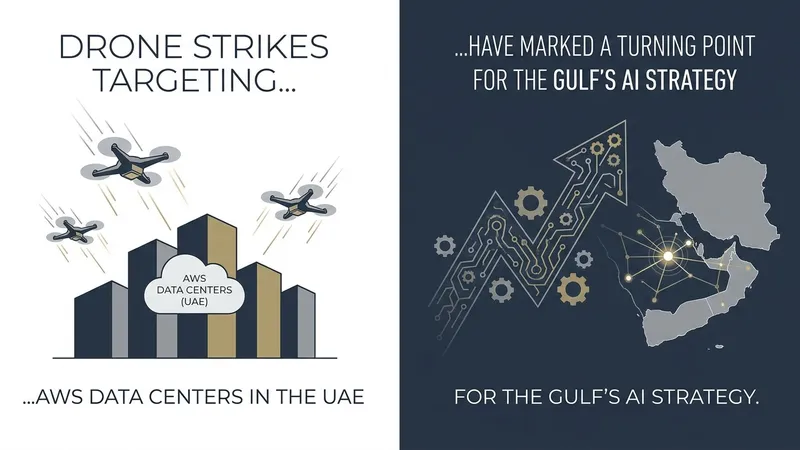
Early in the Middle East conflict, two Amazon Web Services (AWS) data centers in the UAE were targeted by drone strikes. Nearly three months later, with oil prices hovering around $100 a barrel and the Strait of Hormuz remaining closed, the Gulf’s ambition to become a global AI hub is facing its first real stress test.
Before the conflict began, the UAE, Saudi Arabia, and Qatar were racing to position themselves at the center of the AI boom. Abundant, low-cost energy, strategic geography, and sovereign wealth backing made the region an highly attractive destination for hyperscalers building data center networks. That value proposition has now fundamentally shifted.
Investment decisions into several major data center projects have been paused or are taking significantly longer. Gary Wojtaszek, CEO of Pure Data Center Group, confirmed that the company has temporarily paused investment decisions in the Middle East. Mark Richards, a partner at law firm BCLP, noted that decisions "are taking longer because of the nature of the risks associated with effectively being in a region that has some serious threats."
Risks that were not part of the original investment thesis are now being actively priced into the process. Trisha Ray of the Atlantic Council put it bluntly: "The ongoing conflict in the Middle East is putting AI infrastructure on the literal front lines in ways that even a year ago would have seemed out of the realm of possibility."
The region's energy economics have also shifted. Gulf markets previously offered industrial power at around $0.11 per kWh versus $0.25 to $0.40 in parts of Europe. However, the war has destabilized global energy markets, with the IEA calling the effective closure of the Strait of Hormuz the largest oil supply disruption in history.
Brent crude surged more than 55% from around $72 to nearly $120 at its peak over three months. UAE gas prices jumped 30% for consumers in April. Even in energy-rich states, cheap, subsidized power is no longer guaranteed for massive industrial users like AI data centers.
The drone strikes on AWS facilities marked an unprecedented escalation, proving that data centers are becoming as strategically sensitive as oil pipelines. Ray suggested that future facilities would need to be physically hardened, potentially built underground, or diversified by building outside the country entirely.
The threat is far from theoretical. Iran’s Islamic Revolutionary Guard Corps released satellite footage of OpenAI’s partner "Stargate" campus in Abu Dhabi, designating it a potential military target. The Gulf’s AI infrastructure is now part of the region’s volatile strategic calculus.
Despite the risks, major Gulf AI players claim the war will not dent their long-term ambitions. G42, the UAE AI champion backed by Mubadala, stated its "conviction has only deepened." Saudi Arabia’s HUMAIN CEO Tareq Amin said the company is committed to "building the full AI stack" and that the Kingdom’s sheer scale remains a strategic advantage.
[AgentUpdate Depth Analysis] The physical targeting of AWS facilities in the UAE exposes a critical vulnerability in the global AI Agent ecosystem: its heavy reliance on highly centralized cloud infrastructure. As multi-agent systems and Model Context Protocol (MCP) integrations scale globally, any physical disruption to regional hyperscaler nodes directly threatens the operational continuity of real-time enterprise Agents. This geopolitical shift will likely accelerate two architectural trends. First, it will drive the adoption of sovereign, localized edge-AI agents that can run autonomously without constant cloud tethering. Second, it will push the development of decentralized Agent routing layers capable of dynamically shifting workloads across geographically isolated and physically hardened cloud regions. Ultimately, the resilience of AI Agent swarms will depend not just on algorithmic efficiency, but on the physical redundancy and geopolitical decoupling of their underlying physical compute.