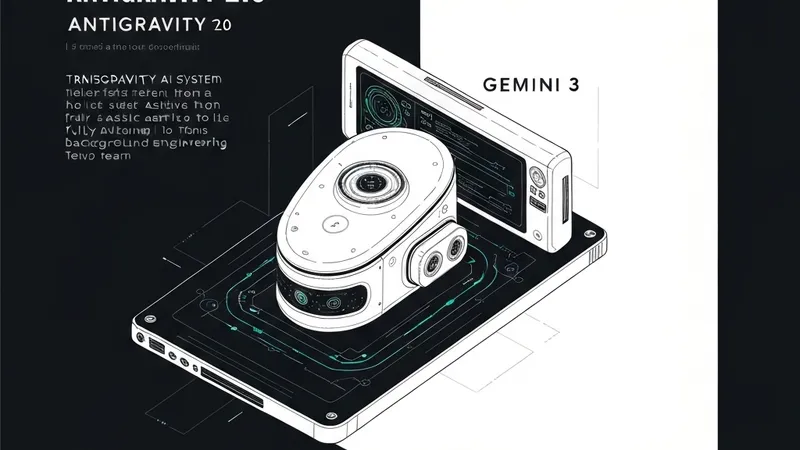
The developer track at Google I/O 2026 made one thing clear: the era of the simple AI chat assistant is over. We have officially entered the Agentic Era. For independent developers and solo founders who rely on "vibe coding," the launch of Google Antigravity 2.0 as a standalone desktop application represents a massive paradigm shift. It takes generative AI out of the browser sidebar and morphs it into a fully contextualized, autonomous background engineering team.
Instead of treating AI as a glorified autocomplete tool, Antigravity 2.0 treats it as an infrastructure orchestrator. Here is a technical breakdown of how this platform works under the hood and why its architecture changes how we write software.
1. The Engine Layer: Why Gemini 3.5 Flash Changes the Economics of Agents
Building autonomous coding loops has historically faced two major bottlenecks: latency and cost. When an AI agent needs to perform sequential tasks—reading a repo, analyzing bugs, running compilers, and iterating on fixes—it consumes massive amounts of tokens. If the model is slow, the workflow becomes impractical. Google bypassed this by co-optimizing Antigravity 2.0 around the new Gemini 3.5 Flash model.
Clocking in at 289 output tokens per second, Gemini 3.5 Flash provides the rapid-fire inference required for real-world agent loops. To preserve context during long-horizon tasks, Antigravity 2.0 utilizes "Event Compaction." Instead of truncating history, the system dynamically compresses older context blocks, saving up to 38% on token overhead during extended debugging sessions.
2. Multi-Agent Orchestration & Parallel Engineering Pipelines
Traditional IDE extensions operate linearly, requiring manual intervention for every step. Antigravity 2.0 rewrites this lifecycle by introducing Multi-Agent Workflows and Dynamic Subagents. Under the hood, a main Antigravity Agent orchestrates multiple subagents simultaneously. For instance, while one subagent handles UI (React/Tailwind), others can concurrently manage testing (Vitest/Regression) and database migrations (Prisma). This parallel architecture allows solo builders to scale their output by managing a virtual engineering squad rather than guiding a single assistant through sequential prompts.