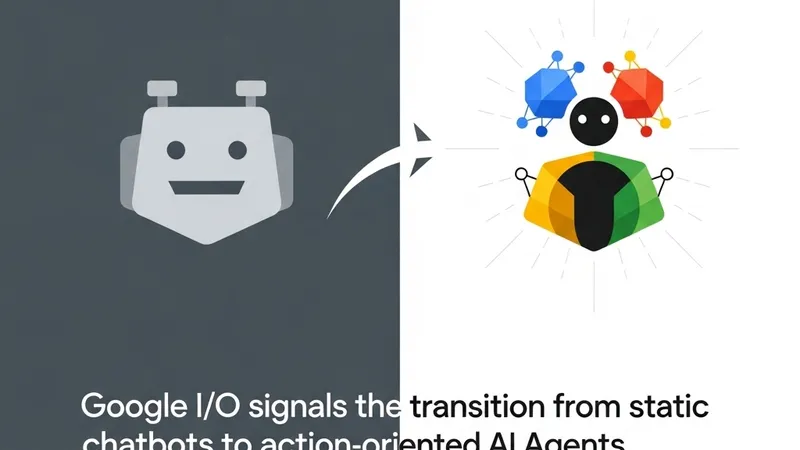
Google I/O 2026 marked a historic transition: the passive, conversational chatbot era is officially over, replaced by autonomous AI Agents capable of long-horizon planning and real-world execution. Here are the 7 key technical takeaways from the event:
1. Native Multimodal Real-time Interaction: Gemini 3.0 delivers ultra-low-latency multimodal streaming. It doesn't just process text, sight, and sound—it predicts user intent in milliseconds, driving Project Astra into a truly proactive companion.
2. RL-Driven Chain-of-Thought Reasoning: Google unveiled a novel architecture merging deep reinforcement learning with generative models, enabling Gemini to perform autonomous error-correction and multi-path planning for complex coding and math tasks.
3. On-device Micro-Agents: The new Gemma 3 family (1B-3B parameters) brings robust reasoning directly to edge devices. These local agents seamlessly coordinate with cloud models, maximizing privacy and off-line functionality.
4. Google Agent Protocol (GAP): In response to community-driven standards like MCP, Google introduced GAP, a unified protocol designed to standardize how AI agents securely interface with databases, APIs, and hardware peripherals.
5. Advanced Web-Use Capabilities: Through deep Chrome integration, Google’s web agents can now navigate complex web forms, perform cross-site data reconciliation, and execute multi-step workflows without requiring bespoke APIs.
6. Active Memory in Infinite Context: Moving beyond raw token capacity, Gemini now features active memory pruning and associative recall, resolving the "needle-in-a-haystack" degradation in ultra-long context windows.
7. Firebase Agents Orchestration: Vertex AI and Firebase have converged to offer a declarative framework for multi-agent systems, simplifying the orchestration, debugging, and deployment of enterprise-grade cooperative AI.
[AgentUpdate Depth Analysis] Google's strategy at I/O 2026 clearly signals that the AI battleground has shifted from raw LLM scale to Agent infrastructure and ecosystem lock-in. While Anthropic pioneers open standards like MCP, Google is leveraging its unmatched distribution channels—Android, Chrome, and Google Cloud—to build an unassailable agentic moat. The introduction of the Google Agent Protocol (GAP) paired with lightweight, on-device Gemma 3 models demonstrates a clear vision: the next operating system is not an OS, but a fluid web of collaborating agents. For global developers, this means the era of simple wrapper apps is dead. The future lies in mastering multi-agent choreography, sovereign local-cloud hybrid execution, and designing complex cognitive loops that can run autonomously across the modern digital estate.