The smart glasses industry has long been a tortured dream of Silicon Valley. The premise is appealing enough: enjoying the benefits of mobile computing without staring at phones all day, simply by wearing a lightweight computing device on one's face. However, for much of the last decade, the industry has resembled a financial black hole where gargantuan investments have been sunk with little to no profit.
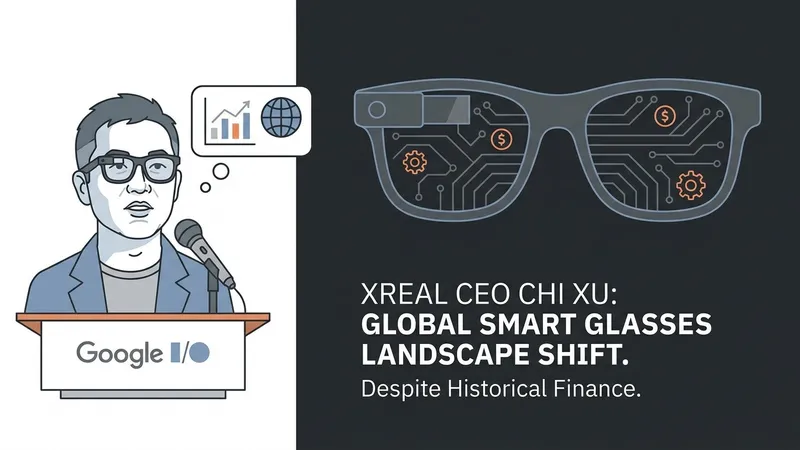
"Everybody’s losing money," said Chi Xu, founder and CEO of Xreal, a longtime partner of Google. Speaking at Google’s I/O conference in Mountain View, Xu was promoting Xreal’s Project Aura, their latest effort to create functional XR glasses that people actually want to use.
For years, the obstacles were obvious: bulky, socially awkward form factors paired with low-utility software. Now, industry insiders feel a turning point is near. This inflection point is partly driven by Meta's 2023 partnership with Ray-Ban, which successfully sold a significant number of units, even though Meta's Reality Labs division still operates at a massive loss.
As form factors shrink and software improves, Xu believes Xreal can lead the space. "You need all the key pieces ready—the hardware, the operating system, and a great user interface," Xu noted.
Xreal’s newest Aura model features wired smart glasses with embedded OLED displays for high-resolution video viewing. It remains tethered to a "puck"—a phone-shaped mini-computer that powers the experience from the user's pocket.
In exchange for this tethered design, users gain richer experiences, including an immersive Google Maps app, VR YouTube videos, and a hand-tracked "painting app" for holographic imagery. It also supports gesture-based gaming and web browsing. Xreal promises seamless experiences whether following a floating recipe, setting up a private workspace, or watching movies on a virtual big screen.
[AgentUpdate Depth Analysis] Smart glasses represent the ultimate physical interface for next-generation AI Agents, driving a paradigm shift from pure wearable tech to spatial computing fused with multimodal AI. While Meta Ray-Ban prioritizes screenless, lightweight audio-AI interaction, Xreal's Project Aura opts for a tethered split-processing model (the "puck") to preserve high-fidelity visual output and robust hand tracking. This approach is highly strategic for hosting advanced AI Agents that require spatial awareness and rich visual overlays. By combining high-resolution OLEDs with Google’s software ecosystem, Aura allows AI Agents to not only listen but also actively "see" and map the physical world, rendering context-aware holographic assistance in real time. This collaboration could lay the foundation for a dominant Android XR ecosystem, accelerating the transition of AI Agents from handheld devices to ambient, face-worn computing.