Every Google I/O has its headline magnet—a faster model, a shinier demo, or a new capability that excites developers. Google I/O 2026 was no exception: Gemini 3.5 Flash boasted impressive benchmark numbers, WebMCP sparked intense debates within the open web community, and AI Studio, Chrome, and Search plunged deeper into agentic workflows.
Yet, the most pivotal developer announcement was not the loudest one. It was the introduction of Managed Agents in the Gemini API.
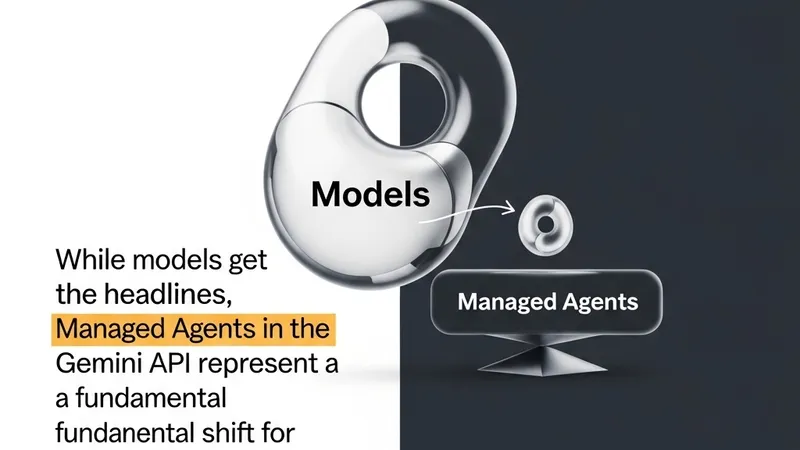
While it sounds less glamorous than a brand-new foundation model, that is precisely why it matters. Models are the engines, but Managed Agents represent the chassis, gearbox, dashboard, and emergency brake. It is the crucial layer that translates "the model can reason and use tools" into "my application can command an agent to perform complex work, observe its execution, maintain state, gather artifacts, and resume smoothly." This is a fundamental paradigm shift for developers.
The Real Bottleneck Was Never Intelligence. For years, agent demos have followed a familiar script: a model receives a prompt, calls tools, generates and executes code, inspects results, and debugs itself. But when developers attempt to ship this to production, they immediately hit the real engineering wall.
The hard part isn't getting the model to think; it's giving it a secure, robust environment to operate. A production-ready agent requires a comprehensive runtime—a sandbox, file systems, tool boundaries, memory, and state management. It demands observability over intermediate execution steps, granular controls for network access, credentials, costs, and automated cleanup.
Google's Managed Agents addresses this head-on by packaging the agent loop itself as a managed developer primitive. With Managed Agents, the Antigravity agent runs inside a Google-hosted Linux sandbox, executing code, managing files, accessing the web, preserving environment state, and returning detailed execution traces through the Interactions API. Instead of spending months building and maintaining the orchestration runtime from scratch, developers can leverage a hosted agent environment and focus purely on defining their product boundaries.
At I/O 2026, Google launched Managed Agents in the Gemini API as a public preview, showcasing the Antigravity agent powered by Gemini 3.5 Flash. Accessible via the Interactions API and Google AI Studio, the release provides a secure, hosted Linux execution environment, persistent file/state management, and comprehensive observability, drastically lowering the engineering barrier for agent deployments.
[AgentUpdate Depth Analysis] Google’s Managed Agents marks a paradigm shift from Model-as-a-Service (MaaS) to Runtime-as-a-Service (RaaS). Historically, developers struggled with setting up isolated sandboxes and state machines using frameworks like LangChain, facing steep security and operational hurdles. By standardizing the agent runtime at the cloud infrastructure layer with secure Linux execution, Google directly challenges OpenAI's Assistants API. This release significantly lowers the friction for enterprise agent deployment and forces the AI middleware ecosystem to redefine its value. Going forward, the battleground for AI Agents will shift from raw LLM reasoning capabilities to the reliability, security, low latency, and deep observability of their execution runtimes.