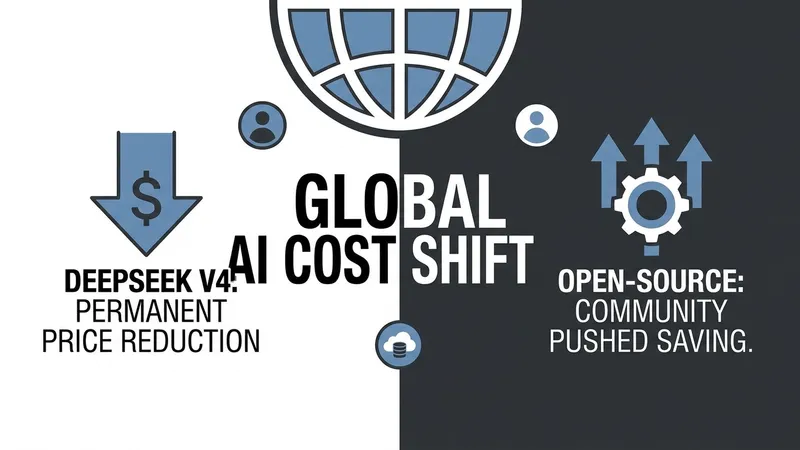
One month after the release of DeepSeek V4, the open-source community is pushing the model's cost-efficiency to unprecedented levels. A new project named Reasonix is rapidly gaining traction on GitHub by optimizing caching specifically for DeepSeek's architecture. By driving the cache hit rate to a staggering 99.82%, Reasonix successfully reduced a bill of over 400 million tokens from $61 down to just $12—effectively slicing input token costs by 80%.
As a terminal-based coding harness dedicated to DeepSeek, Reasonix is built around a single, clear objective: maximizing the utilization of DeepSeek's native automatic prefix-caching mechanism to slash input costs in long-session workflows.
DeepSeek’s prefix-cache is only triggered when the exact byte-level prefix of a request matches a prior one. Traditional AI Agent loops, which frequently reorder context, rewrite history, or inject dynamic timestamps, constantly break this cache. To overcome this limitation, Reasonix introduces an append-only run loop divided into three distinct zones:
First, the Cache-First Loop. It partitions the context into: the System Prompt zone (fixed and calculated once), the Chat History zone (append-only and never rewritten), and the Draft Sandbox zone (where temporary information is refined before being logged). This strictly ensures that the prefix of the byte stream remains completely unchanged across turns, maintaining a 90%+ cache hit rate even in extremely long interactions.
Second, Tool-Call Repair. Addressing DeepSeek's common edge cases—such as missing JSON calls, malformed arguments, duplicate tool invocation storms, and truncated outputs—Reasonix runs up to four validation and repair cycles before actual execution, drastically enhancing runtime stability.
Third, Dynamic Cost Control. By default, Reasonix prioritizes the highly economical V4 Flash. For demanding tasks, it dynamically switches to V4 Pro—either triggered manually via the /pro command, or automatically escalated when error rates cross a critical threshold. Once the difficult turn concludes, it automatically downgrades back to Flash while compressing the context sequence to prevent token wastage.
Getting started with Reasonix is straightforward. Without requiring global installation, developers can simply run npx reasonix code in their project directory to boot up the TUI interface, though a desktop client is also available.
Crucially, Reasonix's maintainers emphasize that the tool is deeply coupled with DeepSeek at every abstraction layer and will not support general-purpose integration. This "model-specific optimization" philosophy has sparked vibrant discussions in the community. While some argue that simple API format-bridging is enough, others maintain that specialized, model-native harnesses deliver unmatched financial and execution efficiency.
[AgentUpdate Depth Analysis] Reasonix highlights a profound shift in AI Agent system design from model-agnostic frameworks to model-native architectures. Historically, developers sought universal wrappers to abstract away model differences. However, the financial breakthroughs of models like DeepSeek rely heavily on infrastructure-level features like Prefix-Caching, which are highly sensitive to formatting shifts. By designing control flows tailored directly to DeepSeek’s bytes-exact caching rules, Reasonix proves that custom 'software-model co-design' at the application layer can yield massive cost reductions. This paradigm of 'programming for caching' suggests that the future Agent ecosystem will be populated by highly specialized, model-native micro-agents rather than just monolithic universal frameworks. Such precise engineering optimizations will be crucial for enterprises aiming to scale production-grade Agent workflows economically.