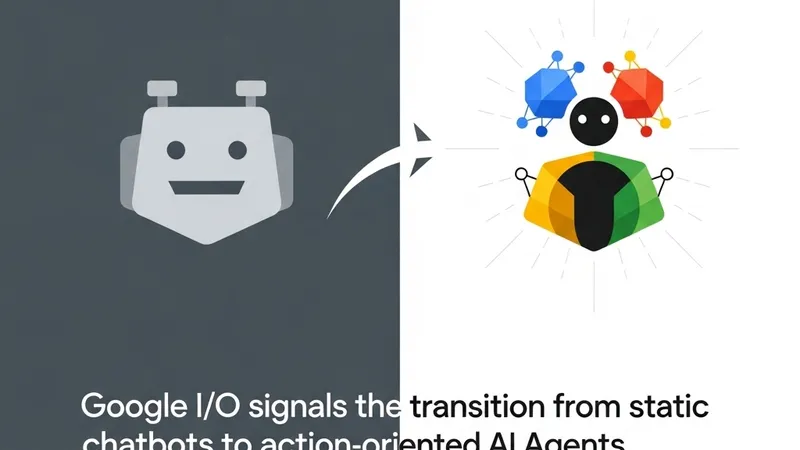
The defining moment of Google I/O 2026 was not the Gemini 3.5 keynote or the new XR glasses. It was the live demo where Jules, an autonomous coding agent, opened a pull request on a GitHub repository and successfully passed the CI pipeline—all while the presenter was still speaking. No human wrote a single line of code; the PR was ready before the slide changed. This is not just a feature; it is a profound paradigm shift.
What I/O 2026 Was Actually About
Every year, Google I/O has an underlying narrative beneath the flashy demos. In 2023, it was "catching up to ChatGPT"; in 2024, "Gemini is everywhere"; in 2025, "multimodality becomes real." In 2026, the story is deeper: Google stopped just building assistants and started replacing the developer's role in the execution loop—not to eliminate developers, but to elevate them into systems orchestrators.
Part 1: The Coordinated Technology Stack
Google's announcements at I/O 2026 form a unified, coordinated technology stack rather than isolated product drops. From the underlying infrastructure and Gemini foundation models to the agent orchestration layer and application frontends, every announcement represents a complete re-architecture of how software gets designed, written, and deployed.
Part 2: Jules — The Async-by-Design Coding Agent
Jules is Google's autonomous, asynchronous coding agent. What makes it technically distinct from previous tools is its async-by-design nature. Prior tools like GitHub Copilot or Cursor are synchronous: the human prompts, waits, reviews, and prompts again, acting as the scheduler and context manager. Jules completely inverts this. You define the acceptance criteria, and Jules works in the background, handling environment issues, running tests, and opening PRs while you focus on other tasks. You shift from being the "CPU" to acting as a Tech Lead who delegates implementation. This fundamentally alters how skills compound (system thinking over syntax), how teams scale (one senior dev orchestrating multiple parallel Jules tasks), and where bugs are caught (PR review quality becomes the ultimate gatekeeper).
Part 3: ADK 1.0 — Agent Development Kit
To enable developers to build and customize their own autonomous agents, Google introduced ADK 1.0. This framework provides standardized tools for environment observation, tool-calling, and state management, providing the necessary software engineering scaffolding to transition AI agents from experimental toys into production-ready engineering assets.
[AgentUpdate Depth Analysis] The introduction of Jules and ADK 1.0 marks a monumental leap from "copilots" to "autonomous AI agents" in software engineering. Compared to pioneers like Devin or GitHub Copilot Workspace, Google leverages its vertically integrated stack—from Android and GCP to Gemini—to deliver enterprise-grade execution. Jules's asynchronous architecture proves that the bottleneck of AI development has shifted from raw autocomplete speed to complex, long-running state management. For the broader AI Agent ecosystem, this accelerates the adoption of standardized communication protocols like MCP (Model Context Protocol). Ultimately, the developer's primary value will transition from writing lines of code to orchestrating multi-agent systems, defining system boundaries, and conducting rigorous code reviews, setting a new standard for future software pipelines.