What is Google's Helpful Content System (HCS)?
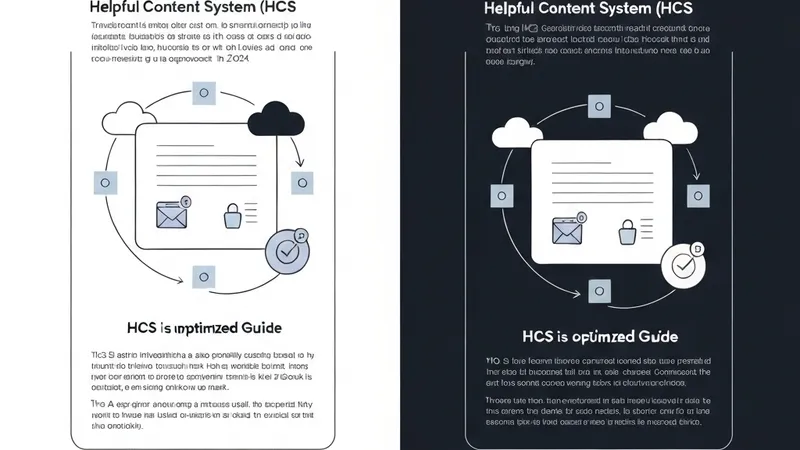
Google's "Helpful Content System" (HCS) is a comprehensive framework used to distinguish content created primarily for people (helpful, original, satisfying searcher intent) from content created primarily for search engine manipulation (derivative, shallow, designed to rank rather than serve). Initially launched as a standalone update in August 2022, HCS was fully integrated into Google's core ranking infrastructure in March 2024 and now operates continuously across all core updates.
This document serves as a dual-purpose installation manual and audit reference for ensuring website content meets HCS standards, installing "people-first" signals, and evaluating existing assets.
Three Operating Modes of HCS Implementation
To streamline implementation, this framework specifies three distinct operating modes:
- Mode A — Install Mode: Building HCS-compliant content infrastructure from the ground up by deploying recommended technical patterns and page-level markup.
- Mode B — Audit Mode: Evaluating existing content against HCS criteria to identify optimization gaps.
- Mode C — Hybrid Mode: Running a comprehensive audit first, followed by targeted technical installation to remediate failing pages.
Cross-Stack Implementation and Claude Code Integration
While standard reference implementations are documented in plain HTML, equivalents exist for all major frameworks including React, Vue, Svelte, Next.js, Nuxt, SvelteKit, Astro, Hugo, 11ty, Remix, WordPress, Shopify, and Webflow. Specific considerations apply to pure client-rendered SPAs (no SSR/SSG) and Tailwind CSS configurations (e.g., purging, dynamic classes, dark-mode CLS, and focus accessibility).
Furthermore, developers can automate the HCS pipeline using the Claude Code CLI tool via the following programmatic flow:
- Read site configuration and collect client variables.
- Run a self-assessment script applying HCS evaluative criteria to each piece of content.
- Identify SEO-first patterns and flag content showing search-manipulative signals.
- Install per-article HCS markers and apply global site-wide technical HCS infrastructure.
- Validate compliance and generate an actionable HCS alignment report.
Conflict Resolution and Penalty Remediation
When addressing legacy content, developers and SEOs must strictly adhere to the following rules:
- Thin content optimized solely for search engines: Flag for either deep enrichment or removal/consolidation. Do not preserve in its current state.
- Manipulative SEO patterns (e.g., keyword stuffing, doorway pages): Remediate or remove immediately. These manipulative patterns generate site-wide negative signals that drag down the organic performance of the entire domain.
[AgentUpdate Depth Analysis] The continuous integration of Google’s Helpful Content System (HCS) into its core infrastructure has profound implications for the AI Agent and RAG (Retrieval-Augmented Generation) ecosystems. As search engines transition to AI-driven answer engines (such as Perplexity, SearchGPT, and Copilot), the quality of the index determines the intelligence of the Agent. HCS acts as a critical upstream filter, purging low-value, LLM-generated spam and forcing the web toward higher information density. For Agent developers, this implies that utilizing raw web-scraping for context building will yield cleaner, more reliable data. Conversely, it sets a strict boundary for generative AI workflows: agents designed to auto-publish SEO-bait will face immediate penalties. The future of the AI Agent ecosystem relies on creating unique, synthesis-driven, and experiential content. Agents must evolve from simple content generators to high-value knowledge orchestrators that naturally align with HCS's human-first paradigm.