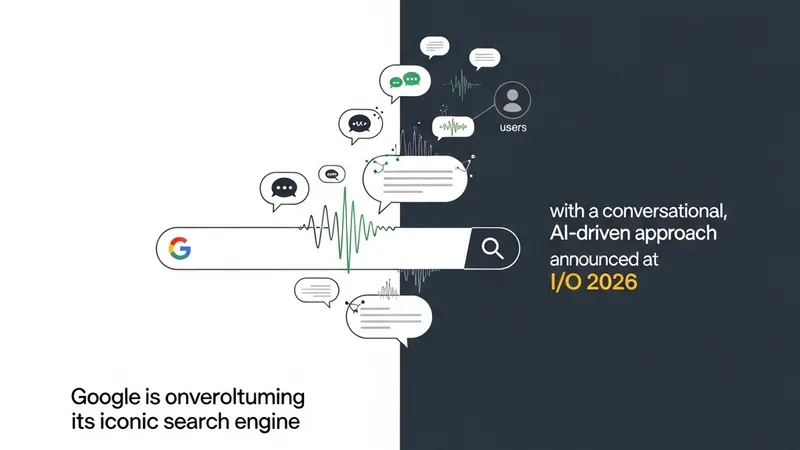
Google is on the verge of looking radically different, and if you are not a fan of the AI Overviews feature, you probably won't like what is coming next. At the Google I/O 2026 keynote, the company announced a massive overhaul of Search to embrace a conversational, AI-driven approach, even inviting users to deploy AI agents to automatically notify them when events like their favorite band going on tour occur.
"This is the biggest upgrade to our iconic search box since its debut over 25 years ago," said Elizabeth Reid, leader of the Search organization at Google. Now, searching on Google prompts users to use "AI mode" right from the start. Even without opting in, results might still feature an AI Overview, complete with a chat box for follow-up questions. Once opened, Google behaves more like ChatGPT than the traditional search engine ingrained in our daily lives for decades.
The announcement did not generate the positive reception Google hoped for. Instead, users view it as another forced push of AI agents and chatbots into consumer software. Following the rocky rollout of AI Overviews—including dangerous advice like telling users to stare at the sun—the public is weary of these rapid adjustments. One comment on Google's video noted, "this is the best advertisement for letting people know it's time to get a different search engine."
Generative AI fatigue aside, users are also growing weary of Google’s search monopoly, which was ruled illegal by a U.S. District Court in 2024. For those seeking alternatives, Kagi offers a compelling, ad-free option. Supported by a subscription fee ($5/month or $10/month for unlimited queries), Kagi bypasses ads entirely. It allows users to customize their search with "lenses"—such as an academic lens to prioritize journal articles over blogs. If users occasionally need AI assistance, Kagi's "Quick Answer" feature provides summaries with source links without being intrusive.
[AgentUpdate Depth Analysis] Google's aggressive push into agentic, conversational search marks a seismic shift from link-based retrieval to direct answer synthesis. However, forcing AI Overviews onto users risks eroding trust and causing "chatbot fatigue." In contrast, niche search engines like Kagi demonstrate that the future of the AI Agent ecosystem lies not in forced AI consumption, but in user agency and curation. By offering custom search "lenses" and paid, ad-free models, Kagi preserves user control. For the broader AI Agent landscape, this tension highlights a critical trajectory: successful future interfaces must position AI Agents as customizable, opt-in tools that respect user intent, rather than monopolistic or intrusive overlays. True innovation will thrive where agents act as personal filters rather than corporate megaphones.