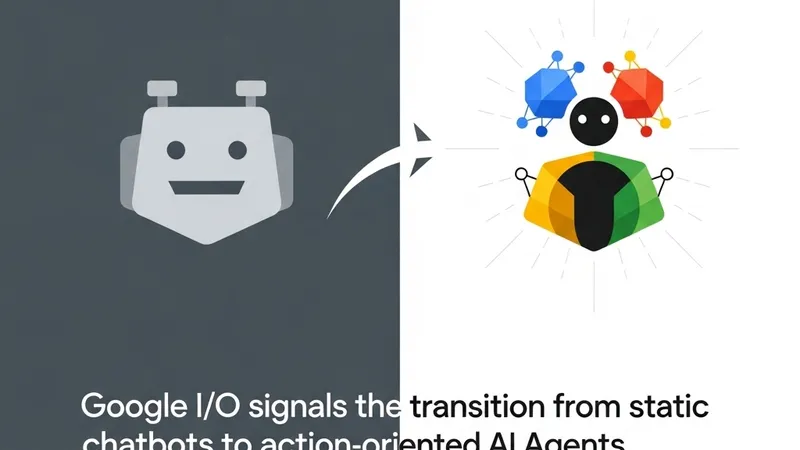
The defining moment of Google I/O 2026 wasn't the Gemini 3.5 keynote or the XR hardware; it was a demo where Jules—an autonomous coding agent—opened a pull request on a GitHub repo with passing CI, all while the presenter was still speaking. No human wrote a single line. This signifies a massive paradigm shift: Google is no longer just building AI assistants; it's shipping AI Engineers.
While previous years focused on catching up to competitors or achieving multimodality, 2026 is about replacing the developer's role in the loop—not to eliminate engineers, but to elevate them. Google unveiled a coordinated technical stack that re-architects software construction. Every announcement slots into a rung of this framework, moving away from isolated product drops toward a complete ecosystem for autonomous development.
Jules stands out because it is asynchronous by design. Current tools like Copilot, Cursor, or Gemini Code Assist are synchronous—the human acts as the scheduler, the CI runner, and the context manager. Jules inverts this: the agent operates independently in the background. You define the acceptance criteria, and Jules delivers the PR while you focus on higher-level tasks. This shift means the AI is no longer just an accelerator for your decisions; it is an executor of your delegation.
This mental model shift redefines the developer's value. Instead of being the 'CPU' managing the state machine of a feature, the developer becomes a Tech Lead. You orchestrate multiple parallel Jules tasks, shifting focus from line-by-line execution to systems thinking and architectural integrity. As a result, PR review quality becomes the critical gate for software reliability. With the introduction of ADK 1.0, Google is signaling that the era of the human-led implementation is evolving into an era of AI-driven engineering orchestration.