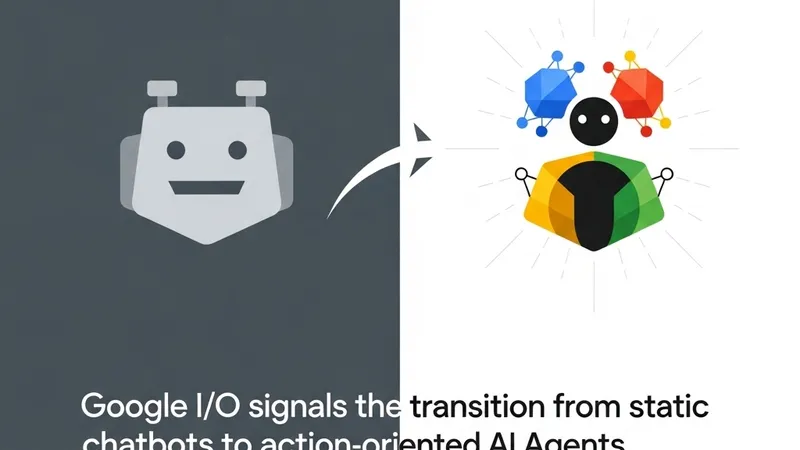
At the recent Google I/O, the tech giant sent a clear message: the era of the simple chatbot is over, and the age of the AI Agent has officially begun. The focus has shifted from mere conversation to action, perception, and deep integration. Here are the seven critical technical takeaways for developers and tech professionals.
First is Project Astra, Google's vision for a universal AI agent. It demonstrates real-time multimodal perception beyond text, using cameras to capture the physical world and perform low-latency logical reasoning. For developers, this means the interaction model is evolving from "prompt-response" to "observe-execute," where AI can process continuous video and audio streams for true environmental awareness.
Second, the Gemini 1.5 Pro context window has officially expanded to 2 million tokens. This leap isn't just about the numbers; it fundamentally challenges the necessity of traditional RAG (Retrieval-Augmented Generation). Developers can now feed entire codebases, hours of video, or massive document sets directly into the context, significantly lowering the barrier to complex long-context reasoning.
On the hardware front, Google introduced Trillium, its 6th generation TPU. Trillium offers a 4.7x increase in compute performance per chip and a 67% improvement in energy efficiency compared to its predecessor. This provides the backbone for large-scale inference and real-time AI apps. Simultaneously, Gemini 1.5 Flash was launched to address high-frequency, low-latency tasks, filling the gap between performance and cost-efficiency.
The event also highlighted breakthroughs in generative media, including the video model Veo and Imagen 3. Veo can generate high-definition video over a minute long with advanced cinematographic understanding. Furthermore, Gemini Nano is becoming multimodal on-device, allowing mobile hardware to process vision and speech locally without uploading sensitive data to the cloud.
Finally, the evolution of Search (AI Overviews) and Workspace automation illustrates how AI is moving from a tool to a partner. AI can now execute tasks across apps—organizing receipts, scheduling meetings, and generating reports autonomously. This marks a shift where AI becomes the core logic layer of the OS, requiring developers to rethink how their apps integrate into this vast agentic ecosystem.