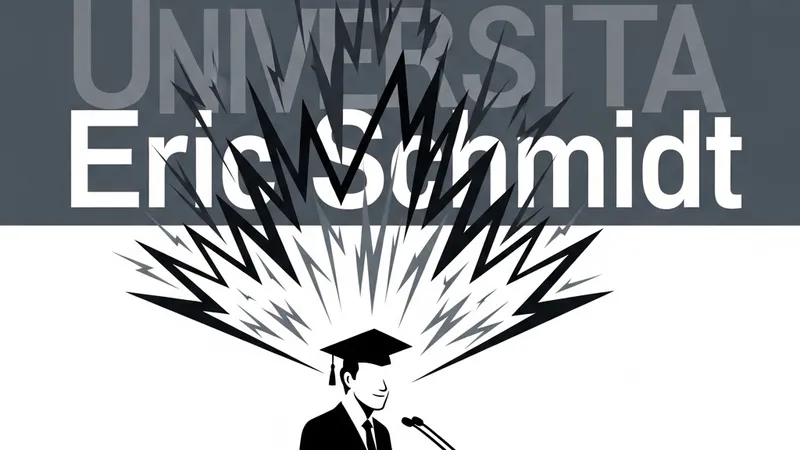
Former Google CEO Eric Schmidt was met with students' boos at a University of Arizona commencement address on Sunday when he raised the topic of artificial intelligence (AI) and its effects. Schmidt, who led the tech giant for over a decade and acquired a multibillion-dollar fortune, was speaking to around 10,000 graduating students when he addressed the impact of modern technology on society.
The topic struck a nerve of anxiety within the student body as he traced technology's evolution, from laptops—which he said had "democratized knowledge" and led to prosperity—to smartphones, the internet, and social media. "We thought that we were adding stones to a cathedral of knowledge that humanity had been constructing for centuries, but the world we built turned out to be more complicated than we anticipated," Schmidt said. "The same tools that connect us also isolate us. The same platforms that gave everyone a voice—like you're using now—degraded the public square," he added, referring to polarization within democracies.
Schmidt noted that information technologies, including AI, had unsettled young people. "That was not the plan, but it happened," he said. Shouting and jeers against Schmidt's talk started when he acknowledged fears that AI threatened to deprive people now entering the workforce of a future.
"I know what many of you are feeling about that," Schmidt said. "I can hear you. There is a fear. There is a fear in your generation that the future has already been written, that the machines are coming, that the jobs are evaporating, that the climate is breaking, that politics are fractured, and that you are inheriting a mess that you did not create." He acknowledged their fears were "rational" and encouraged them to adapt and shape how AI will be used in the future—rather than let it shape them. "The question is not whether AI will shape the world. It will," Schmidt said. "The question is whether you will have shaped artificial intelligence."
The student body's reaction comes days after graduates at the University of Central Florida booed Gloria Caulfield, a real estate executive, when she spoke of "the rise of artificial intelligence is the next Industrial Revolution." Upon hearing the negative reaction, she asked, "Woop, what happened? OK, I struck a chord." She acknowledged that just a few years ago AI was not an issue. "We've got a bipolar topic here, I see," she said. To renewed boos, she added, "AI capabilities are in the palm of our hands."
The Pew Research Center has found that about half of Americans felt the increased prevalence of AI in their daily lives made them feel "more concerned than excited." These fears may be elevated in areas where technology is more easily adopted to replicate information technology work, reshaping the workforce.
[AgentUpdate Depth Analysis] The confrontation between Eric Schmidt and Gen Z graduates underscores a growing systemic friction between rapid AI advancement and cognitive employment. As the AI Agent ecosystem transitions from passive productivity tools to autonomous cognitive entities (driven by frameworks like LangChain, MCP, and advanced reasoning models), entry-level white-collar workflows are being fundamentally disrupted. Unlike previous technological shifts, AI Agents automate end-to-end cognitive processes, directly impacting the career runways of new graduates. To "shape AI" in this era means shifting focus from basic tool utilization to system-level Agent orchestration, governance, and alignment. This tension highlights that the future value of human labor in an Agentic world lies not in executing routine digital tasks, but in defining system guardrails, supervising autonomous agent loops, and solving high-dimensional, real-world ambiguities.