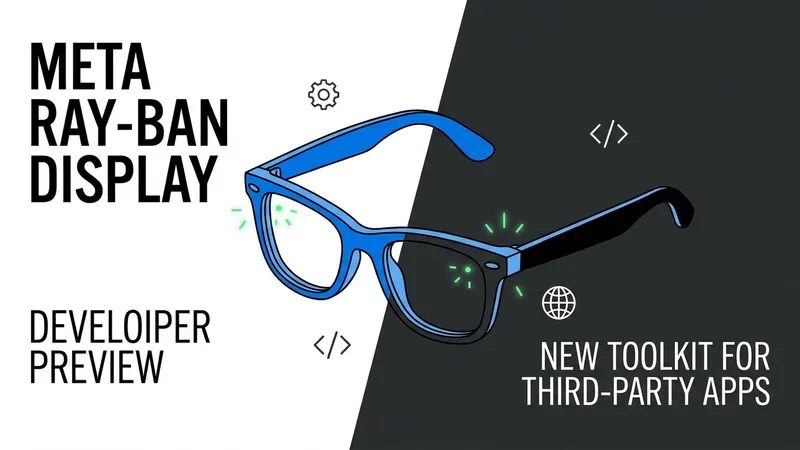
Meta has opened a developer preview of its Ray-Ban Display smart glasses, allowing third-party apps to access the in-lens display for the first time. Developers can now adapt existing iOS and Android apps to show content on the glasses or create standalone web apps using standard web technologies like HTML, CSS, and JavaScript. The platform supports a variety of use cases, including overlays, real-time data streaming, micro-apps, and games.
Access is provided through the Meta Wearables Device Access Toolkit, which includes native SDKs for both Android and iOS. Web apps can be hosted via standard URLs, completely bypassing the need for a dedicated, centralized app store. This dual-track approach gives developers immense flexibility to choose between native app performance and web-based rapid deployment.
The toolkit supports core user interface elements such as text, images, buttons, and video on the in-lens display. Early application scenarios include interactive guides, streaming tools, and minigames. Apps can also tightly integrate with the Neural Band gesture control system that ships with Ray-Ban Display. Meta has not specified any immediate restrictions on app submissions or whether a rigorous review process is in place, signaling that this preview is a collaborative sandbox designed to mature before general availability.
Alongside the developer tools, Meta is rolling out four major features to all Ray-Ban Display owners: Neural Handwriting (gesture-based text input via the Neural Band), display recording to capture on-screen visuals, expanded turn-by-turn navigation in the US and Europe, and broader live caption support. Crucially, Muse Spark—Meta's first proprietary AI model developed by Superintelligence Labs—will arrive on Ray-Ban Displays this summer, bringing advanced conversational intelligence, shopping features, and support for multi-agent tasks.
Meta's decision to open the Ray-Ban ecosystem comes ahead of highly anticipated smart glasses launches from Google, Samsung, and others powered by the Android XR platform. While the timeline for the general release of third-party apps remains unannounced, this move cements Meta's aggressive strategy in the wearable AR landscape.
[AgentUpdate Depth Analysis] Meta's opening of the Ray-Ban Display to third-party developers, coupled with the Neural Band integration, marks a critical pivot towards embodied, multi-modal AI Agent ecosystems. Historically, AI agents on wearables have been limited by voice-only interfaces. By introducing visual rendering and micro-gestural inputs, Meta provides a physical blueprint for multi-agent coordination. The inclusion of the Muse Spark model and upcoming multi-agent support demonstrates that Ray-Ban glasses are transitioning from static hardware into the primary "first-person" sensory gateway for distributed agents. By bypassing traditional app stores through web hosting, Meta is fostering an open, agile environment reminiscent of the Model Context Protocol (MCP) philosophy. This setup will allow micro-agents to dynamically feed real-time visual data to users, paving the way for proactive, contextual, and deeply integrated agentic experiences in everyday life.