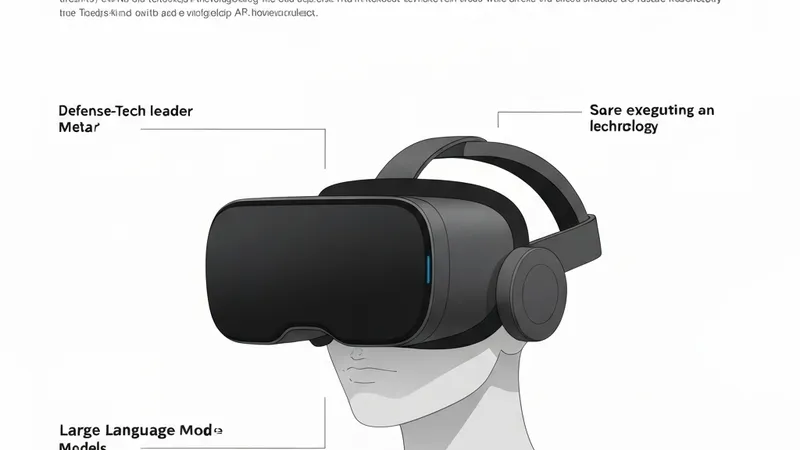
Defense-tech pioneer Anduril has unveiled new details about the military augmented-reality (AR) headset it is prototyping in collaboration with Meta, highlighting a futuristic vision where soldiers can coordinate drone strikes using eye-tracking and voice commands. Led by Quay Barnett, a vice president at Anduril and former Army Special Operations Command officer, the project aims to optimize "the human as a weapons system." Barnett's core vision is to enable soldiers and drones to perceive the battlefield together, share intelligence seamlessly, and make decisions as a unified entity.
Anduril is currently pursuing two separate tracks for this technology. The first is the Army’s Soldier Born Mission Command (SBMC) initiative. Last year, Anduril secured a $159 million prototyping contract to work with Meta on mounting AR glasses onto standard military helmets. Alongside this, Anduril has launched a self-funded initiative called EagleEye, a proprietary helmet and headset combination. Though not officially requested by the military, Anduril expects the pentagon to ultimately purchase the system due to its integrated design.
Both systems are still several years away from deployment. The Army does not expect to transition any SBMC candidate to production until 2028, if at all (notably, Microsoft’s previous $22 billion contract for a similar system was cancelled due to hardware viability issues). However, Barnett shared details with MIT Technology Review regarding the technological path. The glasses will overlay tactical data onto a soldier's field of view, ranging from simple compasses and situational maps to real-time drone flight paths and AI-driven target recognition (such as identifying hostile vehicles).
To interact with the system, soldiers will use natural language to execute tasks like arranging casualty evacuations or planning routes around restricted zones. To translate spoken language into actionable software commands, Anduril is testing integrations with leading large language models, including Google’s Gemini, Meta’s Llama, and Anthropic’s Claude. The underlying engine driving this ecosystem is Anduril's Lattice software, which synthesizes sensory data across different hardware systems. In March, the Army announced a massive $20 billion initiative to integrate Lattice across its entire infrastructure.
Barnett’s team is building the headset to handle complex, multi-step agentic workflows. For instance, a soldier could task an autonomous drone to scan an area and alert them upon detecting artillery. The system would then generate actionable recommendations, such as dispatching a loitering munition to strike, pending chain-of-command approval. Ultimately, Anduril aims to streamline these multi-step operations so they can be executed silently via eye-tracking and gesture interfaces.
[AgentUpdate Depth Analysis] Anduril's partnership with Meta signals a major paradigm shift, migrating AI Agents from digital workspaces and consumer hardware into the high-stakes domain of national defense. This interface is not just an AR upgrade; it is a sophisticated, multimodal Agent orchestration framework. Anduril’s Lattice platform serves as the central middleware, translating outputs from diverse LLMs (Gemini, Llama, Claude) into precise physical commands. By mapping complex military hardware to natural user interfaces (voice, eye-tracking, gestures), this system redefines human-agent collaboration in high-stress environments. This implementation represents the frontier of embodied AI, where software-based cognitive agents orchestrate physical, autonomous edge devices (drones, sensors) under a unified tactical interface. However, the mission-critical nature of warfare will demand unprecedented reliability, pushing the boundaries of AI agent deterministic execution, low-latency processing, and hallucination mitigation in degraded communication environments.