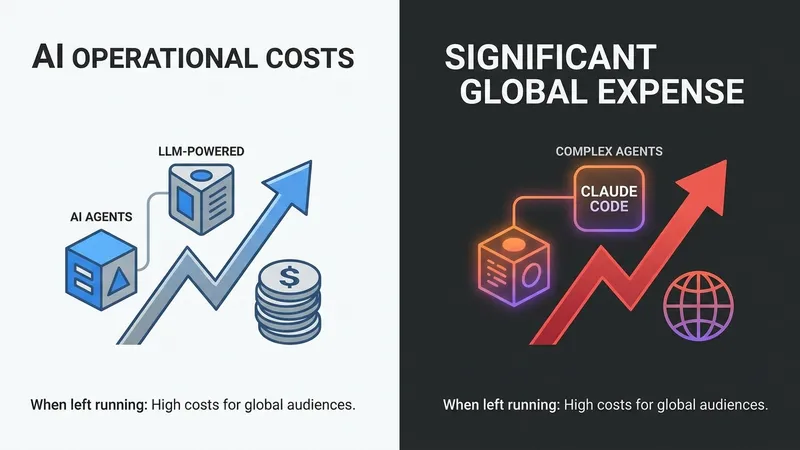
The launch of Claude Code by Anthropic represents a major leap for AI agents, transitioning them from simple chat interfaces to fully autonomous software engineering environments. However, this level of autonomy introduces significant financial risks. Left unattended, AI agents can easily get stuck in infinite execution loops or consume massive amounts of tokens during complex refactoring tasks, resulting in unexpected and exorbitant API bills.
To mitigate these risks, live telemetry and observability specifically designed for AI agents have become crucial. Traditional LLM monitoring tools, which typically log only isolated request-response pairs, fall short for tools like Claude Code. These agents operate within complex ReAct (Reasoning and Acting) loops, continuously calling system tools, reading files, and executing terminal commands, which exponentially inflates token usage.
The core of implementing live telemetry for Claude Code lies in capturing low-level network traffic and tool-calling sequences. By leveraging OpenTelemetry-compliant agents or lightweight proxies, developers can intercept communications between the Claude CLI and the Anthropic API. This setup provides real-time visibility into the agent’s inner thought process, enabling dynamic auditing and precise cost estimation of every action, such as file reads or execution commands.
Practically, by routing Claude Code's execution logs to observability platforms like LangSmith, Arize Phoenix, or OpenLLMetry, developers can visualize runtime metrics on live dashboards. If the telemetry system detects an anomalous token consumption rate, a potential loop, or an individual task cost exceeding a predefined threshold, it can trigger alerts or automatically terminate the process, providing a robust guardrail for production deployments.
[AgentUpdate Depth Analysis] As AI Agents transition from experimental novelties to production-grade automation tools, the core focus of AI engineering is shifting from pure model accuracy to runtime unit economics. The cost volatility of Claude Code highlights a critical truth: unmonitored agents are financial black holes. While traditional APM tools are ill-equipped to map the non-linear, stateful nature of Agent DAGs and tool execution flows, LLM-native observability fills this vital gap. Moving forward, telemetry will evolve from a debugging convenience into a non-negotiable architectural layer—acting as the "brakes" and "middleware gateway" of the Agent ecosystem. Establishing token-level, step-by-step telemetry is the only path to enterprise trust, which will ultimately dictate the commercial viability of autonomous agent frameworks.