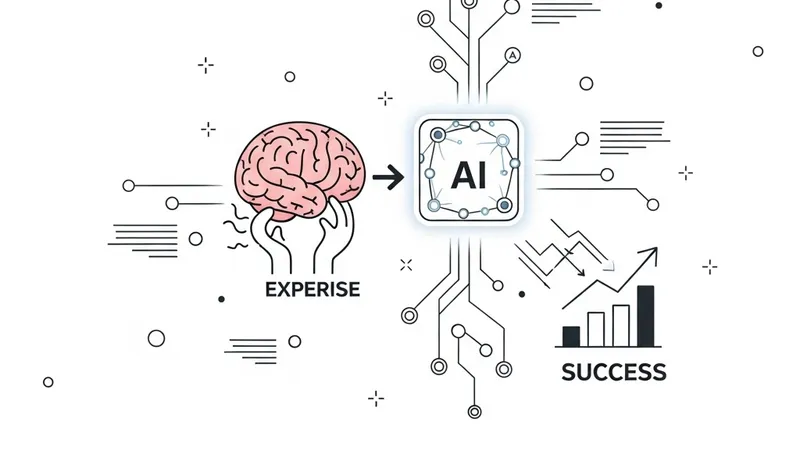
For decades, the idea that artificial intelligence can beat humans at number-crunching tasks like high-frequency trading has been widely accepted. But strategic foresight—the ability to predict the success of high-stakes, uncertain business ventures—has long been held as a uniquely human superpower, driven by qualitative insights and business intuition.
However, a new study co-authored by Felipe Csaszar (professor of strategy at the University of Michigan's Ross School of Business), Aticus Peterson (New York University), and Daniel Wilde (Indiana University) suggests that large language models are beginning to surpass human strategic prediction capabilities. This shift implies that businesses may no longer need to compete on rare, specialized strategic forecasting skills, but rather on how effectively they integrate AI-generated insights into their workflows.
To test the AI's boundaries, the researchers conducted a prospective prediction tournament using 30 live crowdfunding technology projects. Crucially, these ventures were launched after the training cutoffs of the AI models, ensuring the systems had no prior data to rely on. Various LLMs completed 870 pairwise comparisons to rank predicted fundraising success, which were then benchmarked against predictions from 346 business managers and three investors trained in MBA programs.
The results were stark: top-tier LLMs significantly outperformed human experts. While the best human forecasters correctly identified the winner in about 3 out of 5 comparisons (a 60% success rate), the top-performing model, Gemini 2.5 Pro, achieved a correlation of 0.74, correctly identifying the successful venture in nearly 4 out of 5 cases (approx. 80%).
Additionally, the research highlighted a phenomenon dubbed the "augmentation trap." This occurs when human-AI collaboration actually degrades overall decision quality compared to AI working solo, primarily because human cognitive biases, skepticism, or overconfidence lead them to override the AI's highly accurate, unbiased analytical predictions.
[AgentUpdate Depth Analysis] This study marks a pivotal transition of LLMs from tactical assistants to autonomous strategic decision-makers. As AI demonstrates superior qualitative prediction capabilities, the AI Agent ecosystem will increasingly shift toward "Decision Agents." Instead of just generating content, future multi-agent networks will run complex business strategy simulations, assessing product-market fit objectively. However, the discovery of the "augmentation trap" is a crucial warning. It suggests that naive human-in-the-loop workflows may introduce cognitive bias that degrades the agent's superior analytical performance. Moving forward, the key challenge in agentic system design will not be improving model intelligence, but architecting interfaces that properly calibrate human-agent trust, shifting humans from direct micro-managers to high-level system supervisors.