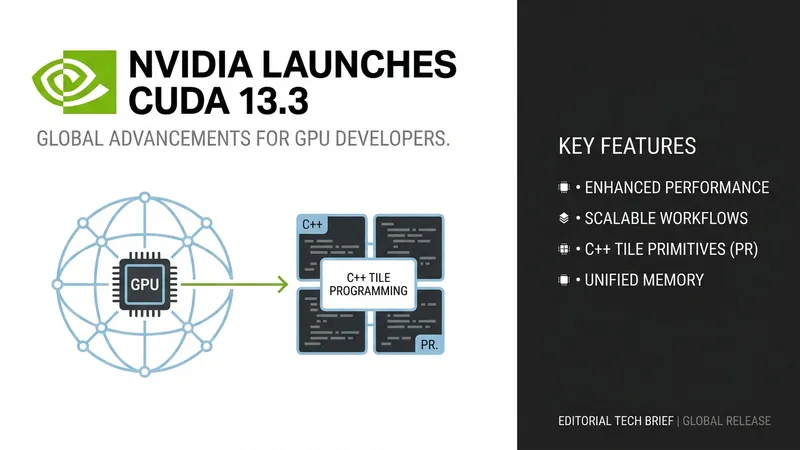
NVIDIA has rolled out CUDA 13.3, introducing significant capabilities and performance optimizations for developers within the CUDA ecosystem. A highlight is the launch of NVIDIA CUDA Tile programming in C++, enabling high-level, tile-based kernel development that automatically manages complex, low-level GPU details for optimal performance and portability. This Tile programming is now supported on Compute Capability 9.0 (NVIDIA Hopper) GPUs, in addition to all other supported GPU architectures.
Parallel to this, CUDA Python 1.0 has been released, cementing the support and stability of the CUDA Python software ecosystem. This version introduces critical features such as green contexts and process checkpointing, enhancing the developer experience for Python users.
For performance-focused developers, the newly launched NVIDIA CompileIQ compiler auto-tuning framework delivers up to a 15% speedup on critical kernels like GEMM and attention. The CUDA 13.3 release also features official C++23 support in NVCC, expanded tensor interoperability with DLPack/mdspan in CCCL 3.3, and numerous updates to the math libraries (cuBLAS, cuSPARSE, cuSOLVER) and profiling tools (Nsight Compute and Nsight Systems).
CUDA Tile C++ Release
With CUDA 13.3, CUDA Tile support extends to C++, empowering the extensive existing C++ codebase and developer community to create highly optimized GPU Tile kernels. This model automates parallelism, memory movement, asynchronous operations, and other low-level details, resulting in C++ code that is portable across NVIDIA GPU architectures.
CUDA Python 1.0 Release
CUDA Python is a collection of libraries that expose CUDA to the Python programming language. The 1.0 release signifies NVIDIA's commitment to semantic versioning, ensuring that breaking API changes will only occur during major-version releases. Minor releases will add features, and patch releases will address bugs. Any public API slated for removal will first be deprecated in a minor release, complete with a clear replacement path.
Key software components included in CUDA Python 1.0:
cuda.binding: Low-level Python bindings to CUDA C APIs (next major version: 13.3.0)cuda.core: Pythonic access to CUDA Runtime and other core functionality (next major version: 1.0.0)cccl-cuda: Pythonic access to CCCL parallel algorithms, providing easy use of CCCL’s highly efficient and customizable parallel algorithms (next major version: 1.0.0)cuda-pathfinder: Utilities for locating CUDA components installed in the user’s Python environment (next major version: 1.6)
Additionally, cuda.coop is available in the cuda-cccl package under the _experimental namespace, subject to potential API changes. cuda.coop offers reusable block-wide and warp-wide device primitives for use within Numba CUDA kernels.
cuda.core Now Stable
cuda.core provides a Pythonic interface to the CUDA runtime, encompassing devices, streams, programs, linkers, memory resources, and graphs. Version 1.0 consolidates APIs that have been stabilizing over previous release cycles into a single, supported surface. Support for green contexts has also been added.
[AgentUpdate Depth Analysis]
The release of NVIDIA CUDA 13.3 marks a pivotal advancement for the burgeoning AI Agent ecosystem. AI agents, from conversational bots to autonomous systems, increasingly rely on high-performance GPU acceleration for inference, complex perception tasks, and intricate decision-making processes. The new C++ Tile programming model significantly lowers the barrier to entry for developing highly optimized GPU kernels, allowing agent developers to focus more on algorithmic innovation rather than low-level hardware intricacies. This abstraction simplifies the creation of custom operations crucial for specialized agent architectures, enhancing both performance and portability across diverse NVIDIA GPU platforms, a critical factor for deploying agents at scale.
Furthermore, the stabilization of CUDA Python 1.0 is a game-changer for agent developers who predominantly work in Python for rapid prototyping and deployment. A stable, feature-rich Python interface ensures more robust and maintainable agent frameworks, while green contexts and process checkpointing can enable more resilient, long-running agent processes essential for continuous learning and operation. The up to 15% speedup from the CompileIQ autotuning framework directly translates to faster agent response times and increased throughput, crucial for real-time interactive agents or those processing vast amounts of data. Collectively, these CUDA 13.3 enhancements democratize high-performance computing for AI agents, fostering innovation and accelerating the development and deployment of more sophisticated, efficient, and reliable AI agent solutions across industries.