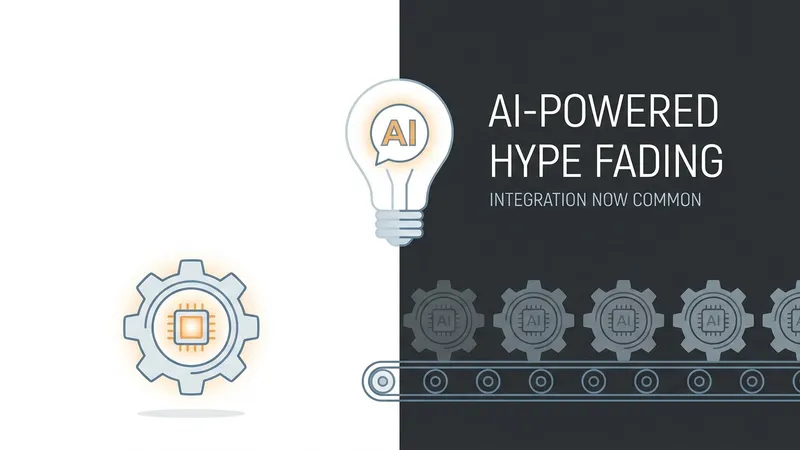
Not long ago, slapping ".ai" onto a domain or claiming to be "AI-powered" was a guaranteed ticket to securing multi-million dollar VC funding. Today, that golden era is officially over. "AI-powered" has faded into marketing white noise. When every legacy SaaS vendor integrates an LLM API and every application crams in a chatbot, simply having AI is no longer a differentiator—it is table stakes.
The root cause of this shift is the rapid commoditization of generative AI. With API costs plummeting and high-performing open-source models like LLaMA and DeepSeek closing the gap with proprietary giants, access to baseline intelligence has been democratized. When anyone can build a decent LLM wrapper in a weekend using LangChain or Cursor, the underlying model ceases to be a competitive moat. AI is undergoing the same evolution as "mobile-first" or "cloud-native" did in previous decades: shifting from a disruptive novelty into standard infrastructure.
Consequently, the survival of AI startups now hinges entirely on strategic positioning. Winners will stop selling generic "generative AI" and start selling "deterministic business outcomes." Enterprise buyers do not care whether an application runs on Claude 3.5 Sonnet or GPT-4o; they care about specific workflow execution. Instead of positioning as an "AI writing assistant," successful teams are positioning as "automated FDA-compliant clinical trial report generators for global pharma." Deep vertical integration into high-value workflows is where budgets reside.
This shift in positioning also demands a fundamental evolution in product architecture. Early AI tools relied heavily on Copilot interfaces that required constant user prompting, shifting the cognitive load back to the human. The next generation of market leaders is pivoting toward autonomous AI Agents. Rather than waiting in a chat window, these agents operate in the background, executing multi-step workflows, interacting with APIs, and delivering finished work. Startups that integrate these agents seamlessly into existing enterprise tech stacks will build immense defensibility and high switching costs.
[AgentUpdate Depth Analysis] The death of the "AI-powered" label signals a mature transition from raw technology curiosity to pragmatic agentic integration. As foundation models commoditize, the battleground shifts entirely to the orchestration layer. The future belongs to AI Agents that can autonomously navigate complex corporate environments. Technologies like Model Context Protocol (MCP) are enabling a major shift from closed SaaS silos to open, interoperable agent ecosystems. Startups that succeed will not just build smarter wrappers; they will deeply re-engineer industry-specific workflows, leveraging proprietary feedback loops to create defensible user value. Ultimately, positioning is no longer about "what AI you use," but "what organizational friction your autonomous agent eliminates."