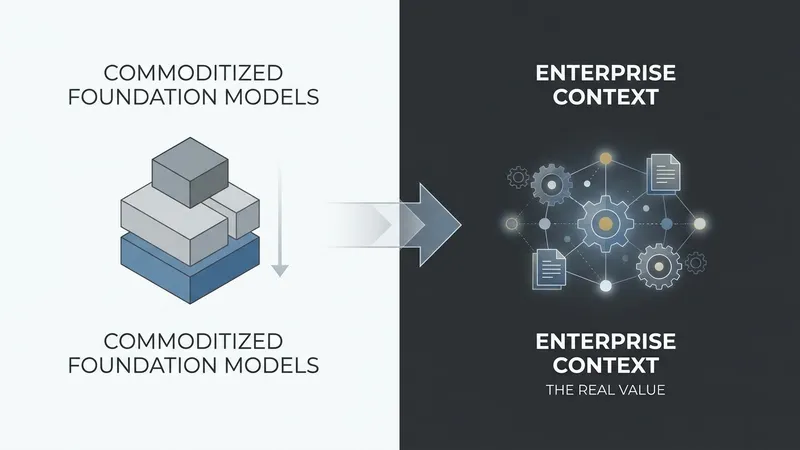
In the early days of the generative AI boom, the industry's focus was almost entirely on "foundation models." Enterprises and developers closely watched every update of GPT-4, Claude 3.5, or Gemini, trying to capture the first-mover advantage. However, as open-source models rapidly catch up and proprietary models converge in both intelligence and pricing, a stark reality has emerged: foundation models are quickly becoming commoditized.
When everyone has low-cost access to equivalent machine intelligence, simply calling an API no longer yields a sustainable competitive moat. So, where is the next battleground for enterprise AI? The answer lies in "Enterprise Context."
Enterprise Context refers to the proprietary, non-public assets accumulated by an organization over years of operation: private customer data, historical decision-making logs, custom workflows, industry-specific terminology, and internal collaboration patterns. Without this context, even the most capable LLM is just a highly knowledgeable outsider. Only when injected with deep, domain-specific context can an AI truly comprehend business intent and execute high-value tasks.
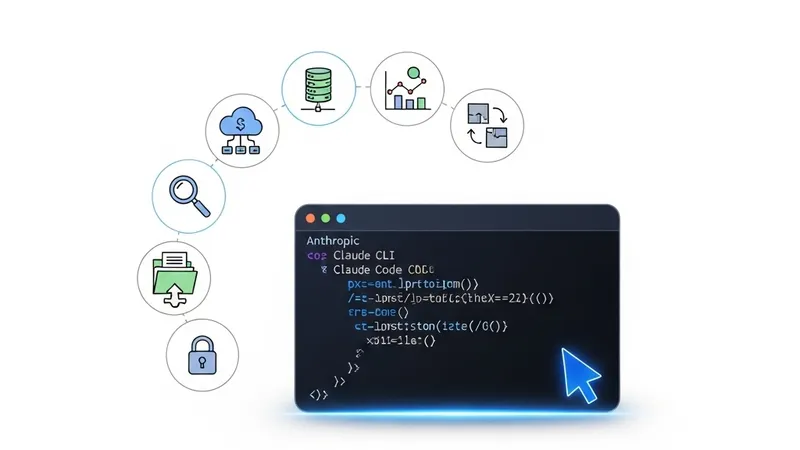
Currently, the tech stack is being refactored around the capture and delivery of this context. From costly and rigid fine-tuning to Retrieval-Augmented Generation (RAG) and million-token long-context windows, developers are searching for the most elegant ways to feed enterprise data into AI. With Anthropic's release of the Model Context Protocol (MCP), this process is becoming standardized, breaking down data silos and enabling AI to interact with internal databases and SaaS tools securely and in real-time.
In the future, the winners of the AI race will not be defined by which foundational model they use, but by how effectively they build, maintain, and securely expose their unique enterprise context to AI systems.
[AgentUpdate Depth Analysis] The commoditization of foundation models shifts the value capture from raw compute to proprietary data integration. Looking at the AI Agent roadmap, traditional static RAG is evolving into active, dynamic context-aware agents. New protocols like MCP essentially act as "universal data sockets" for agents, signaling a transition from model-centric architectures to context-centric agent networks. The core competition is no longer about "who has the smartest model," but "whose agents can most seamlessly navigate the capillaries of enterprise workflows." For the AI agent ecosystem, the Context Layer will emerge as the next highly lucrative tech stack, directly driving the transition of AI from simple conversational chatbots to fully autonomous digital workers.