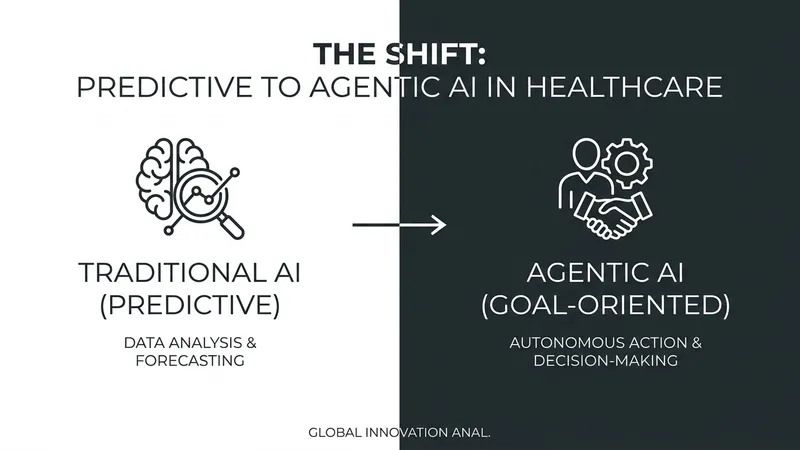
Over the past decade, artificial intelligence has made remarkable strides in healthcare. However, we are currently at a critical inflection point: transitioning from "Traditional AI," which focuses on classification and prediction, to "Agentic AI," which possesses autonomous planning, tool integration, and execution capabilities. This paradigm shift is not just altering technical architectures but is actively reshaping clinical workflows and hospital operations.
Traditional healthcare AI (such as CNNs for radiology or classic machine learning for risk prediction) acts primarily as a static assistant. These systems excel at executing single tasks on bounded datasets, such as segmenting tumors in an MRI or predicting readmission risks. Despite their high accuracy, their outputs are static. Humans must manually bridge these outputs into the clinical workflow. Traditional AI lacks contextual reasoning, proactive planning, and cross-system orchestration, leaving it isolated within the broader clinical ecosystem.
In contrast, Agentic AI in healthcare brings a disruptive capability. Powered by Large Language Models (LLMs) with advanced reasoning, these agents do not just process data; they utilize tools (APIs) and orchestrate actions. An AI clinical agent can read a patient's lab report, identify anomalies, autonomously query the hospital's EHR system via FHIR standards to retrieve medical history, check for drug-drug interactions, draft a comprehensive clinical summary, and prepare referral letters for the clinician to review. This evolution from "passive insights" to "end-to-end execution" defines the value of Agentic AI.
In practical scenarios, Agentic AI demonstrates immense value. For instance, in chronic disease management, traditional apps merely alert patients when biometric data crosses a threshold. An active health agent, however, can analyze continuous sensor data, cross-reference it with dietary logs, dynamically engage with the patient to assess symptoms, and adjust recommendations. If critical risks are detected, the agent can coordinate with the scheduling system to book a doctor's appointment and draft a clinical brief. Administratively, agents can automate prior authorizations and compliance documentation, significantly reducing clinician burnout.
Nevertheless, the zero-tolerance nature of healthcare presents massive hurdles for Agentic AI. Hallucinations in LLMs can have fatal consequences in clinical settings. Furthermore, data privacy regulations like HIPAA demand strict guardrails. Ensuring patient privacy while allowing agents to interact with external APIs and legacy IT infrastructure remains the primary challenge for developers and regulatory bodies like the FDA.
[AgentUpdate Depth Analysis] The transition from traditional AI to Agentic AI in healthcare represents a shift from passive decision-support tools to active workflow orchestration. Traditional models excel at isolated pattern recognition, but Agentic AI introduces autonomous reasoning, tool usage, and continuous planning. This allows clinical agents to bridge the gap between static EHR data and dynamic patient care. However, the high-stakes nature of medicine mandates strict 'Human-in-the-Loop' guardrails to mitigate LLM hallucinations. The future of healthcare AI lies in secure, federated multi-agent systems that coordinate seamlessly via interoperable protocols like FHIR or MCP. Organizations that master the balance between agentic autonomy and rigorous clinical safety will lead the next decade of digital health transformation.