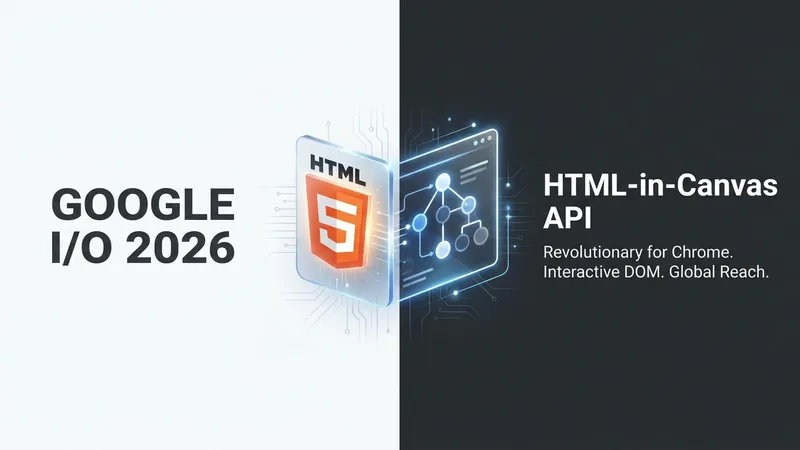
Among the announcements at Google I/O 2026, the update that immediately stands out is the new HTML-in-Canvas API announced for Chrome.
At first glance, it might sound like a small rendering update, but this could become one of the most important improvements to the modern web platform for graphics-heavy and real-time applications. For developers deeply invested in real-time applications, multiplayer systems, browser graphics (WebGL/WebGPU), and interactive map-based experiences, this announcement directly connects with the core of modern web engineering.
The Long-standing Canvas Dilemma
For years, developers had to make a hard choice between using the DOM (HTML/CSS) or Canvas/WebGL/WebGPU. The DOM provides accessibility, text selection, browser translation, SEO, forms, and browser-native interactions. On the other hand, Canvas offers performance, GPU rendering, advanced graphics, particle systems, and immersive visual experiences.
The problem is that once content enters canvas, it usually becomes raw pixels. This means text is no longer selectable, accessibility becomes incredibly difficult, native browser features stop working, and developers often have to manually rebuild complex UI systems. Google’s new HTML-in-Canvas API aims to bridge this gap by allowing developers to render actual DOM elements inside canvas-rendered environments while fully preserving native browser features and interactivity.
Why This Matters for Next-Gen Projects
For projects involving real-time maps, spatial interfaces, or multiplayer browser games (such as the map-based social app "BirdInk"), developers have historically faced a massive challenge: combining GPU-powered rendering with accessible UI. The common workaround was layering HTML on top of canvas and manually synchronizing their coordinates, which quickly became messy in large-scale systems.
With HTML-in-Canvas, an interactive map-based application can feature accessible map labels, interactive profile cards, and browser-searchable text inside GPU-rendered map scenes. Instead of treating everything as raw pixels, the interface remains natively interactive.
[AgentUpdate Depth Analysis] The introduction of the HTML-in-Canvas API marks a pivotal moment for the evolution of AI Agent user interfaces (Spatial UI). As AI Agents transition from static chat inputs to dynamic, spatial, and multimodal operating environments, they require UIs that are both high-performance and semantically accessible. Previously, rendering complex interfaces in WebGL/WebGPU turned the UI into a "pixel desert" impenetrable to Agent vision and screen readers. By embedding fully accessible and interactive DOM elements inside a GPU-accelerated canvas, HTML-in-Canvas provides AI Agents with clear semantic maps of rich graphical environments. This enables next-generation Agents to seamlessly read, interact with, and manipulate elements within 3D spaces and real-time canvas tools, drastically lowering the latency of human-agent collaboration.