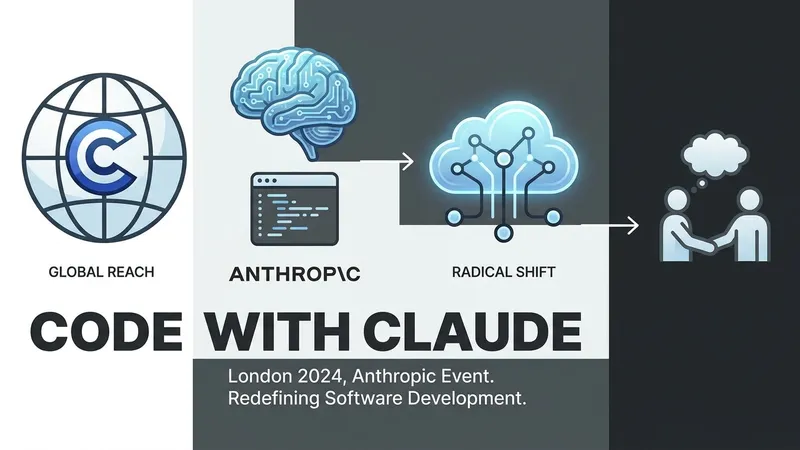
The vibes were strong at Code with Claude, Anthropic's two-day event for software developers in London. 'Who here has shipped a pull request in the last week that was completely written by Claude?' Jeremy Hadfield, an engineer at Anthropic, asked from the main stage. Almost half the people in the packed room raised their hands. 'Who here has shipped a pull request that was completely written by Claude where they did not read the code at all?' Hadfield asked next. Amid nervous laughter, most of those hands stayed up.
It is no longer news that LLM-powered tools like Anthropic's Claude Code and OpenAI's Codex have upended the way software gets made. Top tech companies now boast about how little code their developers write by hand. 'Most software at Anthropic is now written by Claude,' Hadfield remarked. 'Claude has written most of the code in Claude Code.' OpenAI, Google, and Microsoft make similar claims. Even so, it is striking how fast this new paradigm has set in. This time last year, Anthropic had just released Claude 4, which could code only passably. But with the latest string of updates—especially Claude 4.6 and 4.7 released in February and April—Claude Code has become a tool that developers are eager to hand their entire workflow off to.
Anthropic says its ultimate goal is to push automation as far as it can go. Instead of humans cleaning up AI-generated mistakes, the company wants Claude to check and correct its own work. 'The default isn't "I'm going to prompt Claude"—the default is now "I'm going to have Claude prompt itself,"' said Boris Cherny, head of Claude Code.
In this ideal setup, human developers won't even see error messages. Claude will handle testing and tweaking entirely in the background. As engineer Ravi Trivedi put it: 'The key principle is getting out of Claude's way. We like to say: "Let it cook."' Trivedi demonstrated a new feature in Claude Managed Agents—Anthropic's cloud-based setup for multi-agent systems—called 'dreaming.' In this mode, Claude agents write internal notes to themselves, recording and saving thoughts to optimize reasoning and autonomous action without human intervention.
[AgentUpdate Depth Analysis] The shift from conversational coding assistants to autonomous agentic systems is accelerating. By enabling Claude to 'prompt itself' and introducing the 'dreaming' feature for self-reflection within Claude Managed Agents, Anthropic is bypassing the limitations of human-in-the-loop dependencies. While early tools like GitHub Copilot functioned as inline autocomplete, Anthropic's vision centers on multi-agent execution loops capable of self-debugging and background reasoning. For the AI Agent ecosystem, this marks a transition from simple tool-use to fully stateful, reflective, and goal-oriented software engineering agents. Moving forward, the barrier to software creation will plummet, and the primary role of developers will transition from syntax writing to system design and guardrail orchestration.