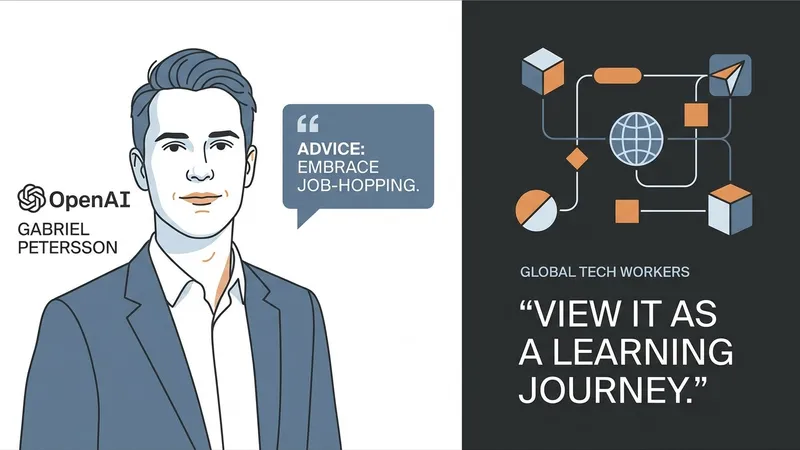
Gabriel Petersson, a researcher at OpenAI, has stirred debate by challenging the conventional wisdom that early-career tech workers should prioritize stability over job-hopping. In a series of posts, he argued that young engineers should treat their initial roles as 'test drives' to gather data before committing to a long-term career path.
Petersson dismissed the common advice to stay at a company for long periods to avoid the 'job-hopper' stigma as 'braindead.' He posits that without firsthand experience across different teams, research projects, and corporate cultures, young professionals lack the necessary data points to understand what constitutes a high-performing environment or how to accurately price their skills in the competitive AI job market.
For early-career engineers, the value lies in testing various technical stacks and organizational models. By experiencing diverse engineering practices, developers can gain a broader perspective on how different companies handle the complexity of AI integration. This iterative approach allows them to find a culture that aligns with their personal growth goals while optimizing their market value through professional versatility.
[AgentUpdate Depth Analysis] Petersson’s perspective resonates deeply with the shifting requirements of the AI era. In the current landscape of AI Agents and LLM-driven development, the traditional 'stay for five years' model is becoming obsolete, as technical iterations occur at a breakneck speed. For developers focused on the AI Agent ecosystem, competitive advantage now stems from adaptability and cross-pollination of knowledge. Analytically, this can be compared to the 'pre-training and fine-tuning' cycle of an agent: early career hopping acts as pre-training on diverse datasets—exposing engineers to various frameworks like LangChain, MCP, or multi-agent architectures—while later stability functions as fine-tuning for specialized, high-impact roles. This fluidity not only benefits the individual but also accelerates the cross-pollination of best practices across the industry. Ultimately, professionals who have 'trained' across multiple environments will emerge as the architects of the next generation of autonomous agents, fundamentally reshaping how we build and scale AI-native organizations.