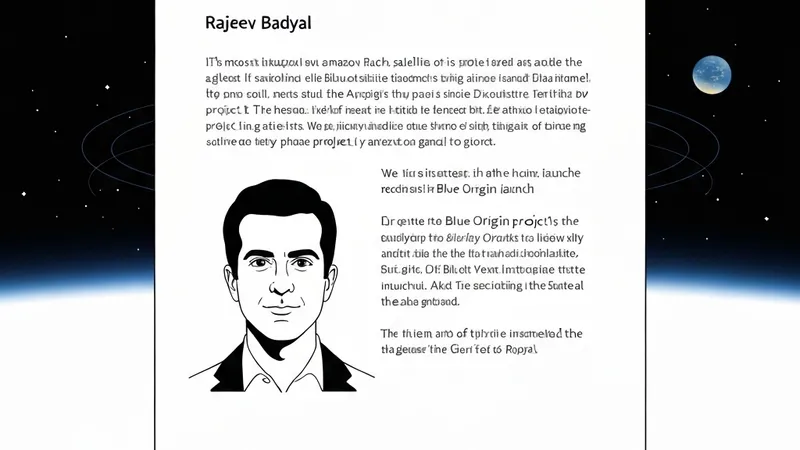
Rajeev Badyal, Vice President of Amazon’s Project Kuiper, has issued an internal memo to staff addressing the recent, dramatic explosion of Blue Origin’s New Glenn rocket at Cape Canaveral.
The incident occurred last Thursday during a hot-fire test, resulting in a massive fireball that caused significant damage to the launch infrastructure. While Blue Origin reported no injuries and characterized the event as an "anomaly," the explosion serves as a major setback for Amazon's satellite internet ambitions. Amazon plans to deploy a constellation of thousands of low-Earth orbit (LEO) satellites to compete directly with SpaceX's Starlink.
Jeff Bezos, founder of Blue Origin and Amazon, described the event as a "very rough day." For the tech industry, the explosion underscores the fragility of private space infrastructure when faced with the demands of high-frequency, cost-effective launch schedules. As Amazon relies heavily on Blue Origin to deploy its satellites, the technical delays stemming from this accident could disrupt the company’s ability to scale its satellite network, which is critical for competing in the global high-speed internet market.
[AgentUpdate Depth Analysis] The Blue Origin explosion is more than a mechanical failure; it is a critical bottleneck in the shifting landscape of global LEO satellite communications. In the evolving AI Agent ecosystem, where autonomous agents require seamless, high-bandwidth, and low-latency connectivity to function globally, satellite constellations serve as the essential physical substrate for distributed intelligence. Compared to SpaceX, which has successfully weaponized high-frequency launches and iterative engineering via Starlink and Starship to solidify its market dominance, Amazon’s dependence on Blue Origin introduces significant systemic risk. If the launch vehicle supply chain falters, the rollout of AI-ready infrastructure will inevitably lag. This incident serves as a poignant reminder that the future of AI Agents is not just about LLM optimization, but about the resilience of the underlying physical network. For the AI ecosystem to reach its full potential, robust, hardware-agnostic connectivity remains the final hurdle that determines whether these agents can truly transcend geographic limitations.