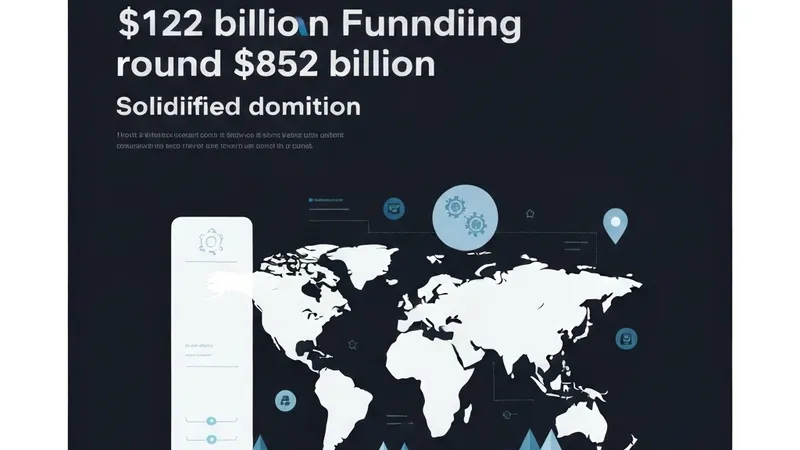
OpenAI, the parent company of ChatGPT, announced Tuesday it has closed a fundraising round of $122 billion, pushing its valuation to an impressive $852 billion. This substantial capital injection solidifies its position as one of the world's most highly valued private companies.
According to the Wall Street Journal, the funding round attracted multi-billion dollar investments from major players including Amazon, Nvidia, and SoftBank, contributing $110 billion. Additionally, a select group of individual investors added approximately $3 billion. This financing ranks among the highest-ever in Silicon Valley, surpassing OpenAI's earlier expectation of $110 billion.
The immense funding announcement comes as OpenAI reportedly eyes a public listing on the U.S. stock market later this year, an initial public offering (IPO) anticipated to be one of the most significant in decades. Despite this momentum, the company is simultaneously navigating multiple challenges, including ongoing lawsuits, advancements from competitors, public skepticism, and broader questions about the sustainability of the AI industry's boom.
OpenAI positions this fundraising as strong evidence of its promising future and the legitimacy of its technology, even as questions persist regarding how the AI boom will deliver on its ambitious promises. In a blog post, the company articulated its vision to construct a "unified AI superapp" that would centralize ChatGPT, its coding products, web browsing capabilities, and the functionalities of AI agents – semi-autonomous bots designed to act on a user's behalf.
The company emphasized that AI is a powerful driver for productivity gains, accelerating scientific discovery, and expanding the scope of what individuals and organizations can achieve. This funding, it stated, provides the necessary resources to maintain its leadership at the scale demanded by the current technological landscape.
Financially, OpenAI disclosed generating $2 billion a month in revenue. However, as reported by the Wall Street Journal, the company incurs billions in annual losses and internal forecasts indicate it does not expect to achieve profitability until 2030.
This positive funding news follows recent setbacks for OpenAI. Last week, the company unexpectedly announced the shutdown of its Sora video generation platform and the termination of a $1 billion partnership with Disney. Sora had previously been touted by OpenAI and CEO Sam Altman as a landmark product and a significant entry into the entertainment and social media sectors.
Earlier this month, OpenAI also quietly discontinued Instant Checkout, a shopping tool that allowed users to purchase items from retailers like Walmart via its ChatGPT chatbot. The five-month trial of this commerce platform failed to meet its objectives and was subsequently shuttered.
The startup faces intensifying competition from rival AI firms. Anthropic, for instance, has made substantial inroads with its Claude Code product. In December, Altman reportedly issued a "code red" internally, refocusing efforts on enhancing ChatGPT in response to advancements in Google's Gemini AI product.