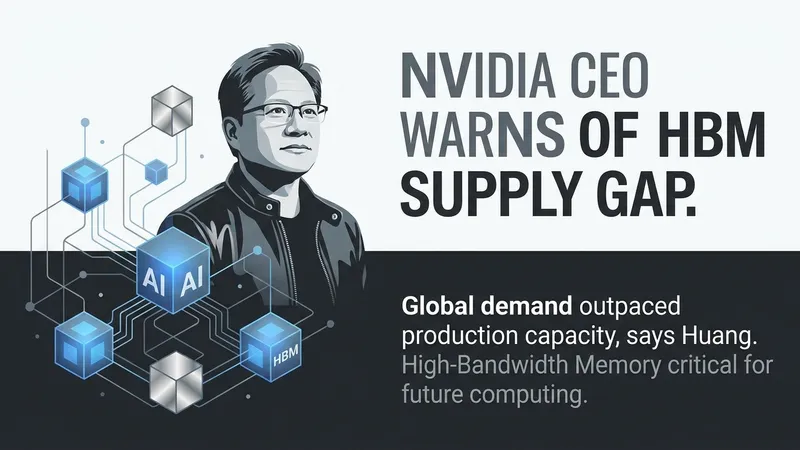
Nvidia CEO Jensen Huang recently highlighted that the demand for advanced memory chips, particularly High Bandwidth Memory (HBM), is significantly outstripping industry capacity. This growing supply-demand gap is emerging as a critical bottleneck for the scaling of AI compute power.
Speaking at a recent industry event, Huang emphasized that next-generation AI architectures, such as the Blackwell platform, demand exponential increases in both memory bandwidth and capacity. As large language models grow in parameter size, the data transfer speed between GPUs and memory has become the defining factor for training and inference efficiency. Nvidia is closely collaborating with memory giants like SK Hynix, Micron, and Samsung to secure future HBM supplies, yet shortages are expected to persist in the near term.
Industry analysts note that HBM manufacturing is highly complex, with slow yield rate improvements and a heavy reliance on advanced 3D packaging. Huang's warnings suggest that memory suppliers will gain significant leverage in the AI hardware supply chain, potentially keeping the cost of AI infrastructure elevated for the foreseeable future.
[AgentUpdate Depth Analysis] The "Memory Wall" has long plagued compute architectures, but in the era of multi-modal AI Agents and ultra-long context windows, this bottleneck becomes critical. The core of an AI Agent lies in its continuous "think-plan-act" loop, which demands frequent retrieval of vast context and real-time reasoning. Huang’s warning of a memory capacity deficit indicates that the token cost for running advanced Agents will not drop as rapidly as expected. This hardware constraint will drive the Agent ecosystem in two directions: first, accelerating the adoption of hybrid cloud-edge architectures and extreme quantization to maximize limited hardware; and second, catalyzing the development of alternative architectures (like Mamba) and memory-efficient agent frameworks (such as MCP). Agent developers must realize that future competitiveness lies not just in algorithms, but in the efficient scheduling and optimization of highly constrained hardware resources.