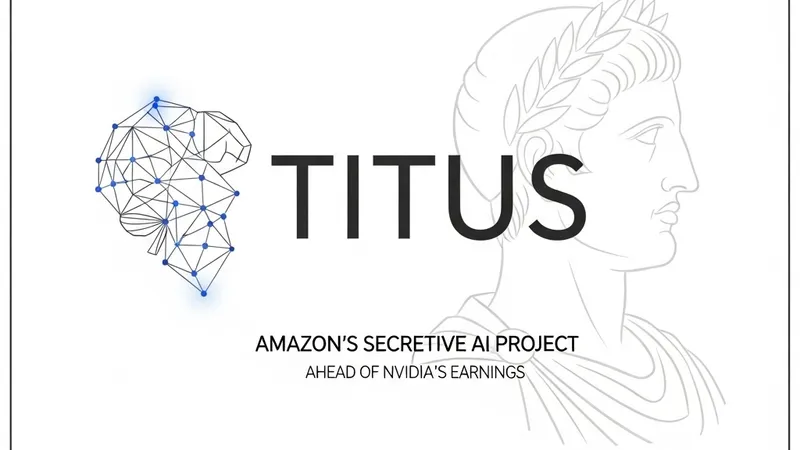
Ahead of Nvidia's upcoming earnings report, details of a secret Amazon AI initiative codenamed 'Titus' have surfaced, shedding light on the chipmaker's immense grip on the cloud industry. Officially, Amazon says the project is named after Roman Emperor Titus Flavius Vespasianus, who completed the construction of the Colosseum—one of history's earliest examples of grand modular architecture. The Colosseum's repetitive, self-supporting arches enabled rapid building and scalable design, principles Amazon now hopes to replicate in its next-generation AI data centers.
However, the codename carries a darker, poetic resonance. Much like the Shakespearean general Titus Andronicus, Amazon is currently performing a perilous balancing act between loyalty to Nvidia and self-preservation.
According to Business Insider's Eugene Kim, 'Titus' is an initiative designed to future-proof Amazon's data centers for Nvidia's impending wave of monster GPU systems, including the heavy-duty GB200 NVL72 racks and beyond. Internal documents reveal that Amazon is aggressively redesigning its power distribution systems, liquid cooling setups, and overall physical infrastructure to handle Nvidia’s massive, power-hungry hardware. While dedicating massive resources to accommodate Nvidia, Amazon is simultaneously rushing to build up its custom silicon efforts, namely Trainium and Inferentia, to avoid perpetual platform lock-in.
[AgentUpdate Depth Analysis] The 'Titus' project highlights a critical tension in the AI Agent ecosystem: the hardware bottleneck of advanced agentic workflows. As AI Agents transition from simple wrappers to multi-agent systems requiring continuous, low-latency reasoning and high-throughput real-time updates, Nvidia’s tightly integrated systems like GB200 with NVLink become indispensable. However, the extreme cost and power requirements of such infrastructure threaten the unit economics of deploying autonomous agents at scale. Amazon’s dual-track strategy—re-architecting data centers for Nvidia while developing its own Trainium chips—is a defensive play to reclaim margins. If proprietary ASICs can match Nvidia's efficiency for specific Agent inference workloads, it will democratize agentic AI, lowering operational costs and facilitating the shift from expensive cloud-bound models to highly distributed, cost-effective Agent networks.