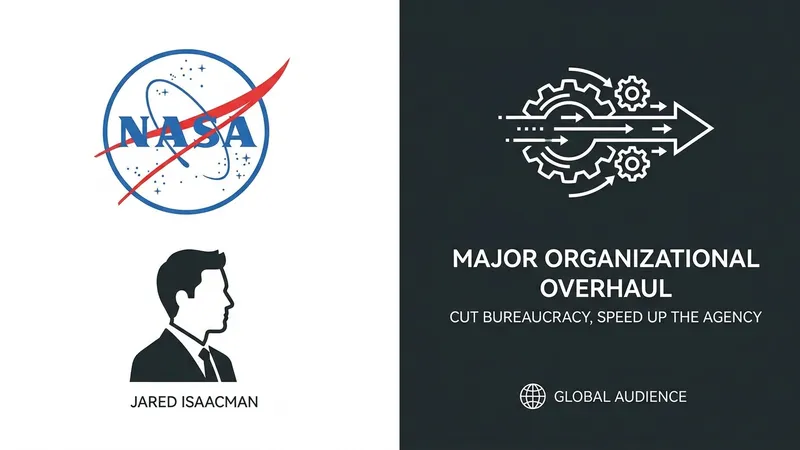
NASA Administrator Jared Isaacman sent a 3,000-word email to employees outlining a major structural reorganization designed to streamline the sprawling agency and accelerate high-priority space programs. The focus is to optimize efficiency as NASA aims to return humans to the Moon and build a permanent lunar base.
“I believe it is imperative to concentrate resources towards the highest priority objectives in the National Space Policy and liberate the best and brightest from needless bureaucracy and obstacles that impede progress,” Isaacman wrote in his letter.
Isaacman stressed that the transition will not cause any layoffs or close any NASA field centers. Instead, the focus is strictly on operational efficiency and sharpening the focus on core missions. These priority directives include: executing the Artemis program; establishing an enduring Moon Base; launching a "Space Reactor Office" to pioneer space nuclear power; accelerating the commercial economy in low-Earth orbit; and building more X-planes alongside launching critical science missions.
The adjustments target a decades-long trend of growing administrative overhead and top-down management at NASA, effectively seeking to decentralize authority and return autonomy back to individual field centers. Former NASA personnel shared with Ars Technica that these shifts are highly encouraging, noting that pushing decision-making power down to local centers is broadly beneficial to executing high-stakes missions.
Structurally, NASA is consolidating its six main "Mission Directorates"—which govern distinct spaceflight, science, and aeronautic sectors—into just four. This consolidation aims to dramatically simplify bureaucracy for program managers, reducing the number of complex internal channels they must navigate to secure resources and make critical design and development decisions.
[AgentUpdate Depth Analysis] NASA’s strategic shift from centralized control to localized empowerment mirrors a fundamental paradigm transition in Multi-Agent Systems (MAS). In large-scale AI agent networks, maintaining a heavily centralized 'orchestrator' agent inevitably leads to massive token overhead, communication latency, and single points of failure. NASA’s organizational restructuring proves that for complex distributed systems, decoupling functions into highly autonomous local nodes is superior. Within the AI Agent ecosystem, this underscores the urgency of utilizing decentralized architectures and standardizing lightweight communication protocols (like MCP). True scalability for future enterprise Agent networks will rely not on increasingly massive central LLMs, but on decoupled, specialized agents carrying out autonomous execution with minimal top-down coordination.