Dreams are our most private thoughts. Yet, most AI-powered journaling apps require users to upload deeply personal emotions, fears, and subconscious experiences directly to centralized cloud servers. RemoraAI was built to challenge this assumption by introducing a privacy-first "Subconscious Social Network."
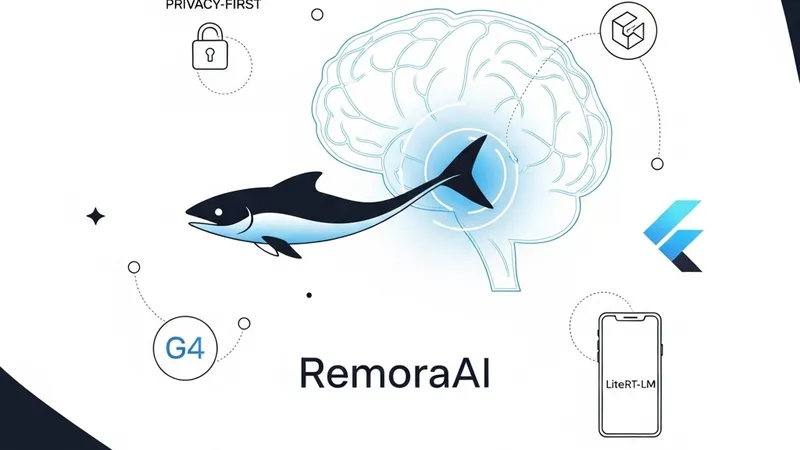
Powered by the Gemma 4 model running directly on-device using LiteRT-LM and Flutter, RemoraAI ensures that sensitive psychological analysis happens entirely locally on the smartphone. The application allows users to record dreams via voice, receive AI-driven psychological interpretations, detect recurring subconscious patterns over time, and generate surreal dream visuals. Optionally, users can publish their anonymized dreams to a public community feed, while raw dream data never leaves the device.
The architecture of RemoraAI leverages a hybrid local-cloud pipeline. The local AI layer utilizes the Gemma 4 E2B model via LiteRT-LM, taking advantage of NPU acceleration for fully offline "Privacy Mode" inference. The cloud layer handles optional dream image generation, the anonymous community feed, and secure transient speech-to-text fallback. Crucially, a memory layer powered by local vector embeddings and Retrieval-Augmented Generation (RAG) manages long-term subconscious pattern analysis.
The developers selected the Gemma 4 E2B model due to its optimal balance of mobile performance, low memory footprint, multimodal capabilities, and advanced reasoning. While previous local models were too heavy for mobile deployment, slow, or lacked nuanced psychological reasoning, Gemma 4 E2B successfully solves these limitations. By running through Android NPUs or Android AI Core, it enables zero-latency offline analysis and drastically eliminates infrastructure costs.
[AgentUpdate Depth Analysis] RemoraAI highlights a critical paradigm shift toward edge intelligence and localized AI Agents. For years, the integration of AI into deeply personal domains has been bottlenecked by privacy concerns and cloud latency. By combining a lightweight foundation model like Gemma 4 with local RAG and vector embeddings on-device, RemoraAI demonstrates that highly personalized cognitive Agents can operate without compromising sensitive user data. This hybrid architecture—local inference paired with optional cloud-based enrichment—serves as a blueprint for future personal companion Agents. As mobile NPU performance continues to accelerate, decentralized, privacy-centric Edge Agents will play a pivotal role in reclaiming user data sovereignty while delivering deep, contextual intelligence.