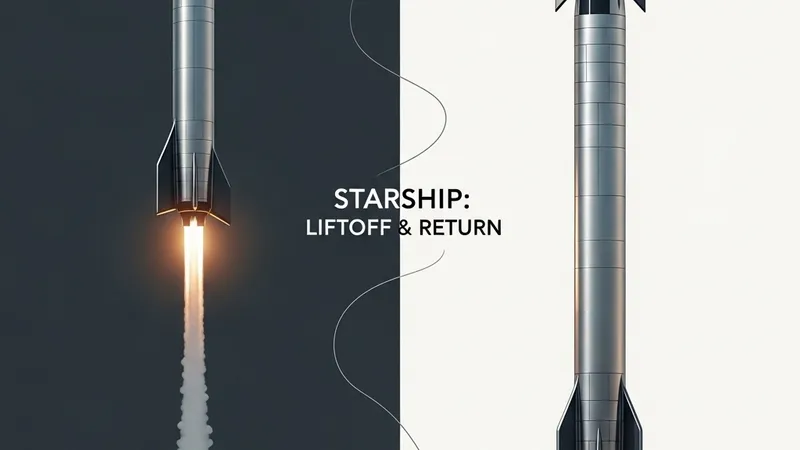
Commercial aerospace giant SpaceX has successfully completed a historic test flight of its Starship spacecraft system. During this mission, the most powerful rocket ever built not only achieved a flawless liftoff from Starbase in Boca Chica, Texas, but also successfully demonstrated the precision recovery of its Super Heavy booster and the controlled splashdown of the Starship spacecraft itself. This double milestone marks a critical leap toward achieving rapid and fully reusable spaceflight capabilities.
According to telemetry data released by SpaceX, the launch phase was highly stable, with all 33 Raptor engines on the Super Heavy booster firing flawlessly and enduring the peak stress of Max-Q. Following a successful hot-staging separation, the booster performed a flip maneuver and returned to the launch site, where it was caught with millimeter precision by the mechanical arms of the launch tower. Concurrently, the Starship spacecraft entered its planned suborbital trajectory, successfully withstood the extreme thermal environment of atmospheric re-entry, and performed a controlled landing burn before a soft splashdown.
Industry experts emphasize that this success validates SpaceX's rapid prototyping and iterative development philosophy. It also provides a significant boost to NASA's Artemis program, which relies on a modified version of Starship to land astronauts on the Moon. Achieving full reusability is expected to exponentially drive down payload delivery costs, accelerating both next-generation Starlink deployments and the broader commercialization of low Earth orbit and deep space exploration.
[AgentUpdate Depth Analysis] The success of SpaceX's Starship is not just a triumph of aerospace engineering, but also the ultimate testing ground for Embodied AI and edge-based AI Agents. During the high-velocity atmospheric re-entry, communication blackouts force the spacecraft to rely entirely on on-board, ultra-low latency Multi-Agent Systems (MAS). These autonomous agents must make millisecond-level decisions to adjust thrusters and thermal protection assets without human intervention. This shift from centralized cloud intelligence to high-frequency edge autonomy represents the next frontier for the AI Agent ecosystem. It transitions AI Agents from simple digital workflow assistants to highly resilient physical world actors. As orbital infrastructure expands, we anticipate a massive surge in space-grade edge computing and collaborative Swarm Agent networks, redefining the limits of autonomous system reliability.